
Subtotal ¥0.00
Discover how AI patient identification enhances accuracy and safety by integrating machine learning with thermal wristbands and EHR systems.
The Persistent Challenge of Patient Misidentification
Patient misidentification remains a critical issue in healthcare, leading to serious safety risks and costly errors. Despite advancements, common causes of misidentification still persist, including:
- Similar patient names and demographics
- Data entry mistakes in Electronic Health Records (EHR)
- Incomplete or outdated patient information
- Manual matching errors during patient registration
Studies show that patient misidentification errors contribute to approximately 10% to 20% of healthcare adverse events, affecting millions globally each year. These errors lead to incorrect treatments, medication mix-ups, and delayed care, directly compromising patient safety.
Financially, misidentification results in increased operational costs due to duplicate testing, denied insurance claims, and potential litigation. Healthcare providers also face regulatory challenges, as strict laws like HIPAA and GDPR require accurate patient data management and secure identification processes.
Traditional patient ID methods—such as handwritten wristbands, barcode scanning, or manual record checks—often fall short because they lack interoperability between systems and cannot reliably prevent errors in real-time. These limitations highlight the urgent need for more sophisticated, AI-driven patient identification solutions to enhance healthcare safety and operational efficiency.
Core Applications of AI in Patient Identification Systems
AI patient identification systems are changing the game by tackling errors that traditional methods often miss. One key use is AI-powered patient matching and deduplication. Using machine learning and natural language processing (NLP), these systems scan electronic health records (EHR) to accurately link patient data and remove duplicates, cutting down on mix-ups.
Real-time biometric patient identification is another strong suit. AI uses fingerprints, facial recognition, or iris scans to verify patients instantly, improving positive patient identification and safety at the point of care.
AI also sharpens clinical trial and research recruitment by matching patient profiles quickly and precisely, ensuring the right candidates are found faster and without manual guesswork.
Risk prediction models powered by AI help flag patients at risk early, sending proactive alerts to staff. This supports timely decisions and proactively reduces harm from misidentification.
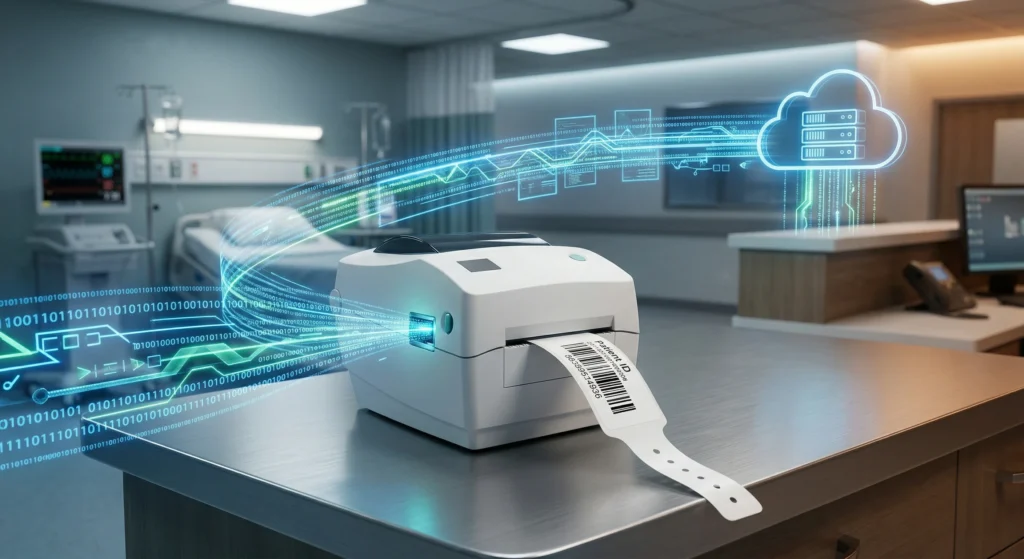
Finally, AI integrates smoothly with physical tools like barcode scanners, RFID wristbands, and thermal wristbands healthcare technologies. This hybrid approach provides multiple layers of verification, boosting accuracy and streamlining workflows in busy healthcare settings.
Together, these AI applications address both data quality and patient safety, making a real difference in daily hospital operations worldwide.
Key Technologies Powering AI Patient Identification
AI patient identification relies on several smart technologies working together to improve accuracy and safety. Here’s a look at the main tools behind these systems:
Machine learning & deep learning: These help spot patterns in patient data, making AI patient matching more precise by learning from past errors and successes. They’re essential for EHR patient deduplication to avoid duplicate records.
Natural Language Processing (NLP): NLP dives into clinical notes and records, extracting key information that traditional ID methods might miss. It plays a big role in pulling accurate patient details from messy or unstructured data.
Biometric AI: Combining AI with fingerprint, facial recognition, or iris scans boosts positive patient identification. When paired with traditional verification methods like ID cards, it reduces misidentification errors significantly.
Predictive analytics & computer vision: These techs analyze data trends to predict risks and verify patients in real time. For example, computer vision can read barcode or RFID wristbands to confirm identities quickly at point-of-care.
Handling de-identified data: AI systems can work with secure, anonymized patient info and still re-identify patients when needed, respecting privacy rules like HIPAA and GDPR while ensuring accurate matches.
Together, these technologies power smarter, safer patient identification systems that help reduce errors, streamline care, and protect patient data across healthcare settings.
Tangible Benefits and Real-World Impact of AI Patient Identification
Using AI patient identification systems brings clear advantages that hospitals and clinics can rely on every day:
| Benefit | Description |
|---|---|
| Improved accuracy | AI patient matching drastically cuts down patient misidentification errors. |
| Enhanced patient safety | Real-time patient verification speeds up care, reducing risks from wrong treatments. |
| Operational efficiency | Automating EHR patient deduplication saves staff time and reduces manual workload. |
| Financial gains | Fewer denied claims and lower litigation risks free up resources and reduce costs. |
| Thermal wristband pairing | Durable thermal wristbands combined with AI offer reliable, long-lasting patient tracking. |
These AI-powered tools, like biometric patient identification and NLP in patient records, help healthcare providers deliver faster, safer, and more efficient care. Pairing AI with technologies such as thermal wristbands or RFID enhances positive patient identification while supporting healthcare patient safety AI goals. This real-world impact is why more organizations worldwide are adopting AI-driven patient identification solutions.
Challenges and Ethical Considerations in AI Patient Identification
When using AI patient identification systems, several challenges and ethical issues come up that healthcare providers must address carefully.
Data privacy and security compliance is a top concern. Systems need to follow strict regulations like HIPAA in the US and GDPR in Europe to protect patient information. AI processes large amounts of sensitive data, so ensuring secure handling and storage is crucial to avoid breaches.
Algorithmic bias and transparency are also significant. AI can unintentionally favor certain groups or make errors if the training data isn’t diverse enough. This can lead to unfair patient misidentification or exclusion. It’s key to use transparent algorithms that clinicians can understand and trust.
Integration challenges with legacy systems pose practical barriers. Many hospitals still rely on older health IT infrastructures, making it tricky to implement advanced AI patient matching and biometric verification without costly upgrades.
Liability and trust-building issues arise as well. Clinicians and patients need confidence that AI-driven identification tools are safe and reliable. Clear guidelines about who is responsible when errors occur help build trust in these systems.
To overcome these challenges, healthcare organizations are adopting mitigation strategies such as:
- Federated learning to keep data localized and private while improving AI models
- Explainable AI models that provide clear reasoning behind decisions
- Human-AI workflows where AI supports but doesn’t replace clinician judgment
By addressing these challenges thoughtfully, AI patient identification systems can improve accuracy and efficiency without compromising ethics or security.
Implementing AI-Enhanced Patient Identification: A Practical Guide
To successfully adopt AI patient identification systems, it starts with a clear assessment of current patient ID processes. Understand where errors happen, what causes delays, and which legacy methods (like manual data entry or simple barcode scans) are holding back accuracy and speed.
When moving forward with AI, focus on technology selection and integration best practices. Choose solutions that combine machine learning healthcare ID, biometric patient identification, and NLP in patient records to ensure seamless patient matching and deduplication. Make sure these tools work smoothly with existing Electronic Health Records (EHR) and physical systems like RFID wristband integration or thermal wristbands healthcare.
Running pilot programs is key before full rollout. These trials help iron out kinks, train staff, and ease the change management process. Skilled training empowers clinicians and support staff to trust AI outputs and operate new devices confidently.
Set clear success metrics to track progress. Focus on improved match rates, lower patient misidentification errors, reduced duplicate records, and overall ROI. Regularly evaluate how AI impacts operational efficiency and patient safety.
Don’t overlook the role of reliable thermal wristbands as an integration backbone. These durable wristbands ensure real-time patient verification at point-of-care, working hand-in-hand with AI for positive patient identification. Their rugged design fits busy healthcare environments globally, helping to reduce errors and speed up care delivery.
By following these steps, healthcare providers worldwide can unlock the full potential of AI, securing safer, more efficient patient identification systems.
Future Trends and Innovations in AI Patient Identification
The future of AI patient identification is gearing up to be smarter and more connected. We’re already seeing AI merge with technologies like IoT patient tracking wristbands, RFID integration, and advanced biometrics to create seamless, real-time verification systems. These tools work together to improve positive patient identification across healthcare settings, making errors even less likely.
Personalized medicine is another exciting area. Using AI, systems can adapt in real-time to a patient’s needs, ensuring accurate ID while supporting tailored treatments. This means your care becomes more precise and efficient, driven by machine learning healthcare ID systems that constantly learn and improve.
On the regulatory side, expect changes that promote better interoperability and patient safety. Discussions around national patient identifiers aim to simplify and standardize identity across systems, helping to reduce duplication errors and make healthcare data more reliable.
Lastly, we’re beginning to see generative AI and multimodal patient profiling gain traction. This means AI can combine data from various sources—biometrics, clinical records, wearable devices—to build a more complete, secure patient profile, improving recruitment for clinical trials and research with unmatched accuracy.
In short, the blend of AI with emerging tech promises a future where patient identification is faster, safer, and truly personalized—helping healthcare providers deliver better care while reducing risks associated with misidentification errors.
