
Subtotal ¥0.00
Explore the science behind alcohol resistant thermal wristbands for hospitals and why durable LinkWin bands are mandatory for safe patient ID
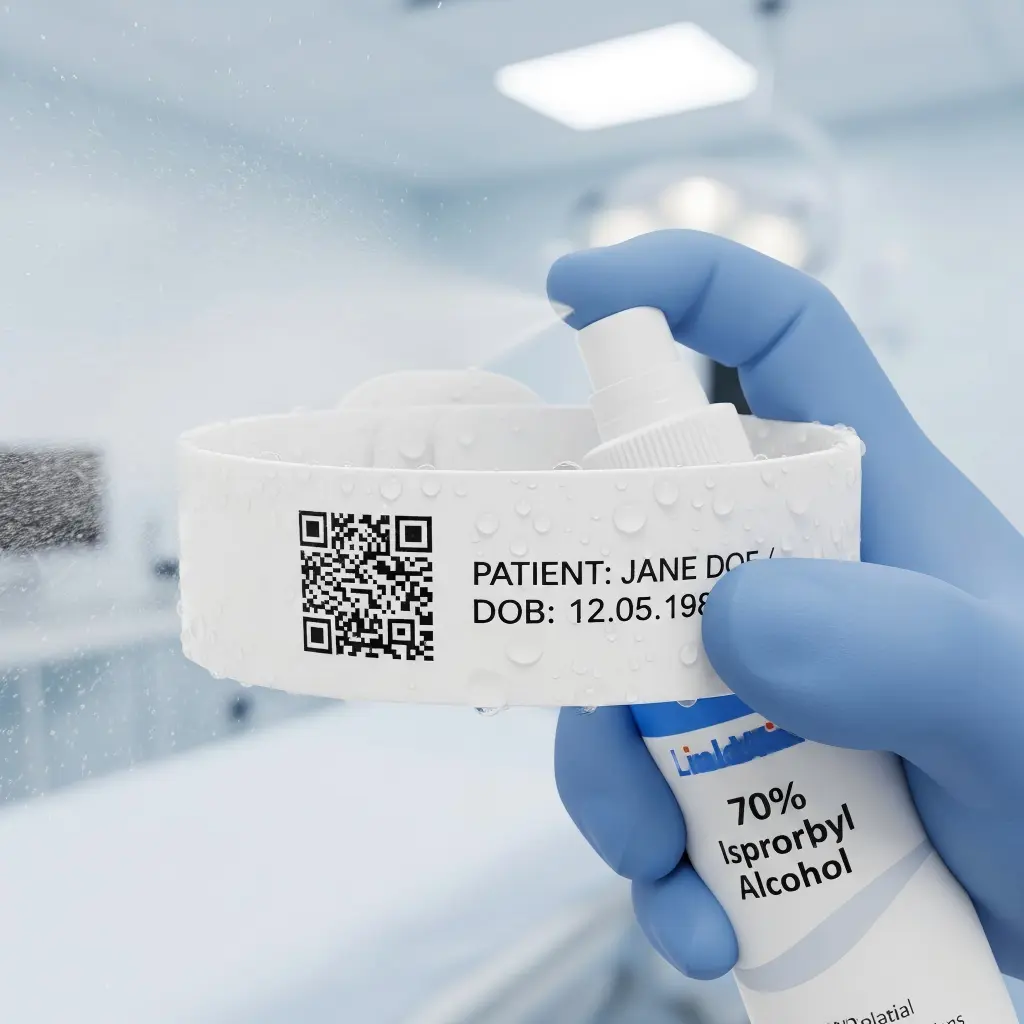
The Chemistry of Failure: Why Standard Thermal Bands Fade
We have all seen it happen. A patient has been in the ward for two days, and their wristband looks like an old receipt left on a car dashboard—faded, patchy, or turned completely black. To understand why this happens, we have to look at the chemistry inside the paper. It’s not just bad luck; it’s a chemical reaction gone wrong.
How Direct Thermal Printing Works
Most people don’t realize that direct thermal printing technology doesn’t use ink at all. It relies on a thermal reaction. The wristband material is coated with a mixture of two key chemicals: a leuco dye (which is colorless) and an acid developer.
When the thermal print head heats up, it melts these chemicals. They mix, react, and turn black to form your text and barcodes. It is an elegant, ink-free solution, but it has a major weakness: the reaction is reversible and sensitive to more than just heat.
The Alcohol Attack: Solvent Interaction
Hospitals are hostile environments for standard paper. Nurses and doctors constantly use hand sanitizers containing high concentrations of isopropyl alcohol. When this alcohol splashes onto a standard thermal band, it acts as a powerful solvent.
The alcohol penetrates the surface and disrupts the chemical stability of the print. It creates a “chemical eraser” effect or, conversely, acts as a trigger that floods the leuco dye reaction.
- The Eraser Effect: The solvent breaks the bond between the dye and developer, causing the text to vanish.
- The Blackout Effect: The alcohol triggers the developer across the entire surface, turning the whole wristband black.
The Result: Unreadable Barcodes
When the chemistry fails, patient safety is immediately compromised. The most dangerous outcome is a drastic drop in wristband scannability rates. A scanner cannot read a smudged or blackened barcode, forcing nurses to manually enter data.
This leads to:
- Compromised Patient Data: Vital information like names and DOBS becomes illegible to the naked eye.
- Patient Identification Errors: Faded text increases the risk of administering the wrong medication.
- Premature Reactions: Bands fail within hours of admission, long before the patient is discharged.
If the wristband can’t survive the sanitizer, it can’t protect the patient.
The Science of Durability: How LinkWin Engineers Resistance
We don’t rely on luck to keep patient data safe; we rely on precision engineering. Standard thermal paper might work for a coffee shop receipt, but it has no place in a critical healthcare environment. At LinkWin, we approach the manufacturing of medical grade wristbands as a chemical engineering challenge, ensuring that the information on the band survives the harsh reality of hospital life.
The Protective Topcoat: Advanced Barrier Technology
The primary line of defense is our proprietary protective top-coating. This isn’t just a glossy finish; it is a functional barrier designed to seal the sensitive thermal layer. This invisible shield performs three critical jobs:
- Chemical Blockade: It stops solvents like isopropyl alcohol from penetrating the surface and triggering the leuco dye reaction prematurely.
- UV and Moisture Seal: It prevents fading caused by overhead fluorescent lights and water exposure.
- Friction Guard: It stops the print from smudging when rubbing against bedsheets or clothing.
Without this specialized coating, Isopropyl alcohol resistance is impossible, and the wristband becomes a liability the moment a nurse uses hand sanitizer.
Material Selection: Synthetic Thermal Wristbands vs. Paper
We strictly avoid standard paper facestocks for patient ID. Paper acts like a sponge, absorbing fluids and tearing under stress. Instead, we utilize high-grade synthetic thermal wristbands, typically crafted from polypropylene.
Here is the breakdown of why material matters:
- Standard Paper: Absorbs water, tears easily, and degrades rapidly when exposed to sweat or humidity.
- LinkWin Synthetic: Completely waterproof, tear-resistant, and chemically inert. It provides a stable base that ensures wristband scannability rates remain high regardless of the environment.
The 15-Day Test: Real-World Endurance
A wristband must outlast the patient’s stay. We subject LinkWin medical solutions to rigorous stress testing that simulates a 15-day hospitalization cycle. This isn’t a gentle lab test; we expose the bands to:
- Continuous Friction: Simulating wear against bed linens and gowns.
- Water Immersion: Replicating daily showers and sponge baths.
- Chemical Exposure: Repeated contact with sanitizers and soaps.
We ensure that our solvent-resistant labels and wristbands maintain 100% readability from the moment of admission to final discharge, guaranteeing that patient safety protocols are never compromised by hardware failure.
The Clinical Impact: Why Resistance is Mandatory
It’s not just about a faded label; it’s about the dangerous ripple effect on patient care. When we design our LinkWin medical solutions, we look closely at what happens at the bedside. If a wristband fails against alcohol or sanitizer, the entire safety net collapses.
Barcode Medication Administration (BCMA) Integrity
The core of modern hospital safety is Barcode Medication Administration (BCMA). This system relies entirely on the wristband being readable to verify the “Five Rights” of medication safety. If the direct thermal printing technology hasn’t been protected against solvents, a simple wipe with an alcohol pad renders the barcode useless.
When the scanner can’t read the code, that critical safety check is bypassed, compromising:
- Right Patient
- Right Drug
- Right Dose
- Right Route
- Right Time
Eliminating Workaround Fatigue
When wristband scannability rates drop, nurses are forced into dangerous workarounds. Instead of scanning, they have to manually type in patient ID numbers. This introduces human error and slows down care. We focus on durability to stop this cycle of inefficiency.
- Operational Cost: Valuable time is wasted reprinting bands.
- Manual Entry Risks: Typing errors can lead to patient identification errors.
- Staff Burnout: Nurses are there to care for patients, not troubleshoot fading supplies.
The Ghost Patient Risk
The most terrifying scenario is the “Ghost Patient.” In an emergency, seconds matter. If isopropyl alcohol resistance is lacking, the text on the band might fade to white after exposure to sanitizers. Medical teams are left with an unidentifiable patient during a crisis. Ensuring strict patient safety protocols means the data must stay legible from admission to discharge, regardless of exposure to hospital chemicals.
Beyond Alcohol: Defending Against Other Hospital Contaminants
While isopropyl alcohol resistance is the headline feature, hospitals are full of other chemical hazards. A wristband that survives a nurse’s hand sanitizer might still fail when prepping a patient for surgery or during daily hygiene routines. At LinkWin, we design our medical grade wristbands to handle the full chemical reality of a clinical environment, not just the lobby.
Betadine and Iodine: Resistance to Staining Agents
Surgical environments rely heavily on strong antiseptics like Betadine and iodine. These are dark, aggressive staining fluids. On standard paper bands, these agents soak right in, turning the white background dark brown or orange.
- The Contrast Issue: Direct thermal printing technology relies on high contrast between black bars and white space. If the background darkens, wristband scannability rates drop to zero.
- The Shield: Our protective top-coating creates a non-porous barrier. Staining agents sit on the surface rather than soaking into the fibers, ensuring the barcode remains crisp and readable even after surgical prep.
Soaps and Foams: Daily Hygiene Impact
Patient hygiene is non-negotiable, but daily exposure to soaps, antimicrobial foams, and water is incredibly tough on healthcare admission supplies. Surfactants in soaps are designed to break down oils, but they can also break down the chemical coating on cheap thermal papers.
- Waterproof vs. Water-Resistant: We use synthetic thermal wristbands (typically polypropylene) that are inherently waterproof.
- Structural Integrity: Unlike paper that turns to mush, our materials withstand friction and daily scrubbing without compromising patient safety protocols.
LinkWin’s Durability Matrix
We don’t guess; we test. To ensure we meet strict requirements for JCAHO patient ID compliance, our engineering team evaluates our solvent-resistant labels against a comprehensive durability matrix. It is not enough to resist one chemical; the band must survive them all.
Performance against common hospital agents:
- Xylene & Acetone: High resistance for laboratory and pathology environments.
- Bleach & Disinfectants: Zero fading or peeling during room cleaning procedures.
- Lipids & Skin Oils: Resists breakdown from natural skin oils and moisturizing lotions.
By covering the entire spectrum of chemical exposure, we ensure that patient identification errors are stopped before they start, keeping data legible from admission to discharge.
Evaluation Criteria for Procurement Managers
When sourcing healthcare admission supplies, looking at the price tag alone is a mistake that can cost you later. As a manufacturer, I see too many hospitals get burned by generic bands that fail under real-world conditions. To ensure you are buying medical grade wristbands that will actually last, you need to scrutinize the technical specifications. We recommend focusing on three non-negotiable metrics to ensure JCAHO patient ID compliance:
What to Look For: Resistance, Readability, and Safety
- Solvent Resistance Rating: Check the datasheet specifically for Isopropyl alcohol resistance. If the material isn’t rated to withstand 70% alcohol or common hospital cleaners, it will turn black or fade within days.
- PCS Retention: This stands for Print Contrast Signal. In plain English, does the barcode stay dark enough against the background to scan? High PCS retention ensures wristband scannability rates remain near 100% throughout the patient’s stay.
- Skin Compatibility: Durability shouldn’t come at the cost of comfort. Ensure the materials are hypoallergenic and latex-free to prevent skin irritation during long-term wear.
The Cost-Benefit Analysis: Pennies vs. Safety
Let’s be real about the budget. It is tempting to save a fraction of a cent per unit by choosing standard paper bands. However, this is risky math. The cost of a single patient identification error—whether it’s a medication mix-up or the operational cost of re-admitting a “ghost patient”—dwarfs the annual cost of premium wristbands.
Investing in LinkWin medical solutions isn’t just about buying a label; it is about buying insurance against data loss. When you choose high-quality solvent-resistant labels, you eliminate the hidden costs of manual workarounds and liability, ensuring that your patient safety protocols hold up when it matters most.
Frequently Asked Questions About Thermal Wristband Durability
Why do hand sanitizers turn thermal wristbands black?
It comes down to basic chemistry. The leuco dye reaction inside the paper is usually triggered by heat from the print head. However, strong solvents like the alcohol found in hospital hand sanitizers can mimic this process. The alcohol dissolves the separation layer, causing the dye and developer to mix prematurely. This turns the background black or washes out the text, destroying wristband scannability rates and leading to patient identification errors.
Are alcohol-resistant wristbands compatible with standard thermal printers?
Yes. You do not need to buy new hardware to upgrade your durability. Our LinkWin medical solutions are designed to be fully compatible with existing direct thermal printing technology found in most hospitals (like Zebra or Honeywell printers). It is a simple swap of the media roll that immediately enhances your patient safety protocols.
What is the difference between paper and synthetic thermal wristbands?
The difference lies in the lifespan and resistance:
- Paper: Suitable only for short-term visitor badges. They absorb moisture and tear easily.
- Synthetic: Usually made from polypropylene. These synthetic thermal wristbands are waterproof, tear-resistant, and provide the necessary base for our protective top-coating. This is the standard for medical grade wristbands.
How does LinkWin ensure wristband durability against hospital chemicals?
We engineer resistance at the molecular level. At LinkWin, we apply a proprietary barrier layer that seals the thermal image. We rigorously test our solvent-resistant labels against common hospital contaminants—including Betadine, iodine, and 70% isopropyl alcohol—to ensure the barcode remains crisp and readable for the entire patient stay.
