
Subtotal ¥0.00
Discover how EMR compatible thermal wristbands bridge digital hospitals improving patient ID safety workflow efficiency and scan accuracy
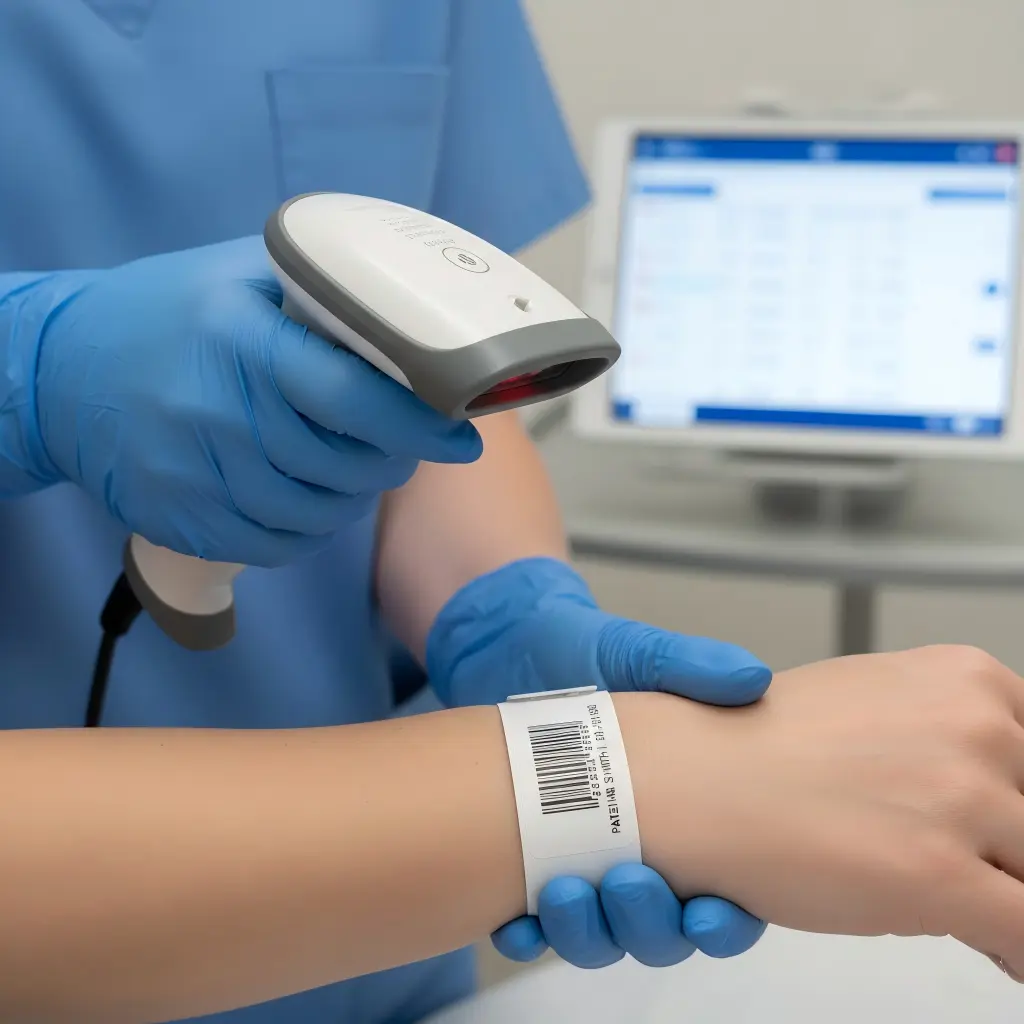
You’ve likely invested millions into your Electronic Medical Record (EMR) system to modernize your facility.
But is there a disconnect between your digital data and the patient in the bed?
Here is the hard truth: Even the most sophisticated software fails if the physical link—the patient ID—is unreadable.
This is the “Last Mile” problem of healthcare.
In this post, I’m going to show you exactly how EMR-compatible thermal wristbands serve as the critical infrastructure for patient safety.
We will cover how to eliminate scanning errors, streamline admissions, and why this hardware choice is the key to Bridging the Gap: How EMR-Compatible Thermal Wristbands Power Digital Hospitals.
Let’s secure your workflow.
The Disconnect: Where Digital Data Meets Patient Care
Ever stood at a bedside, scanner in hand, frantically angling your device to get a read on a wrinkled, smudged wristband? It is the nightmare scenario for any clinician. We invest heavily in digital infrastructure, yet the physical link—the wristband—often fails us. This isn’t just a technical annoyance; it is a critical break in the chain of care.
The Cost of Errors: When Identification Fails
The stakes couldn’t be higher. When patient identification systems fail, we aren’t just losing time; we are risking patient safety. Statistics on medical errors are alarming, with a significant portion traced back to misidentification at the point of care. If we cannot verify identity instantly and accurately, Positive patient identification (PPID) becomes a guessing game.
- Misdiagnosis: Treating the wrong patient based on mixed-up records.
- Medication Errors: Administering the wrong dosage or drug due to failed verification.
- Financial Liability: The immense cost of rectifying preventable mistakes.
Reducing medication errors starts with the wristband. If the barcode doesn’t scan, the safety net disappears.
The EMR Dependency: Garbage In, Garbage Out
We rely on massive systems like Epic and Cerner to orchestrate hospital operations. These platforms are brilliant, but they are data-hungry and demand precision. Electronic Health Record hardware isn’t just about the servers in the basement; it is about the tools in your hand.
Systems designed for EMR integration solutions operate on a simple premise: accurate data input. If the input is flawed because a barcode is unreadable, the entire workflow stalls. Your multi-million dollar software is only as good as the wristband on the patient’s arm.
The “Gap” Defined: Smudged Ink and Manual Workarounds
This is where the “gap” exists. It is the friction point where the digital world meets physical reality. The gap is defined by the limitations of outdated printing methods—laser toner that flakes off or inkjet barcodes that bleed when wet.
When a scanner fails to read a low-quality band, nurses are forced into dangerous workarounds:
- Bypassing BCMA: Skipping Barcode medication administration (BCMA) protocols.
- Manual Entry: Typing in patient IDs manually, which invites typos and data entry errors.
- Wasted Nursing Time: spending valuable minutes troubleshooting printers instead of caring for patients.
This friction undermines the entire digital strategy. To fix it, we need to move away from fragile consumables and embrace EMR-compatible thermal wristbands that are built to survive the harsh reality of a hospital environment.
Why Direct Thermal Technology is the Standard for EMR Integration
When we look at the hardware driving EMR integration solutions today, direct thermal printing isn’t just an option; it is the industry standard. We have moved past the days of trying to force office-grade laser printers to handle the rigorous demands of a clinical environment. The shift to medical grade thermal printing solves specific operational headaches that standard ink and toner simply cannot address.
Thermal vs. Laser/Inkjet: Surviving the Elements
The hospital environment is hostile to standard ink. Between constant hand washing, shower exposure, and the frequent application of alcohol-based sanitizers, laser-printed wristbands often smudge or fade within hours.
Direct thermal medical wristbands function differently. By using heat to activate a chemical layer within the wristband material itself, we eliminate the need for surface-level ink. This creates a print that is inherently resistant to:
- Water and Moisture: Essential for patient hygiene and showering.
- Alcohol and Sanitizers: Withstands the rigorous cleaning protocols required for HIMSS Stage 7 compliance.
- Abrasion: Resists fading from friction against bedsheets or clothing.
Clarity and Scanning: Critical for BCMA
The success of Barcode Medication Administration (BCMA) relies entirely on the scanner’s ability to read the wristband instantly. A faded barcode forces nurses to find workarounds, which defeats the purpose of digital safety checks.
Thermal printers produce high-contrast, sharp images that are superior for 2D barcode scanning in healthcare. Unlike inkjet printers, which can bleed on porous materials, thermal heads lay down precise pixels. This precision is non-negotiable when printing high-density QR codes or Data Matrix codes that contain complex patient data in a tiny footprint.
Maintenance Reduction and IT Efficiency
From an operational standpoint, removing consumables from the equation is a massive win. Laser and inkjet printers introduce multiple points of failure: empty toner cartridges, dried-out ink nozzles, and complex paper jams.
By switching to thermal, we eliminate ink and toner entirely. This reduction in consumables directly lowers the volume of IT support tickets. The printers are simpler, more durable, and designed for the heavy usage of a 24/7 admission desk.
On-Demand Printing: Efficiency at the Point of Care
Laser printers generally require feeding a full sheet of labels or wristbands. If you are admitting a single patient, you often have to waste the rest of the sheet or risk jamming the printer by re-feeding used paper.
Thermal technology enables true point-of-care printing. We can print exactly one wristband at a time, right at the admission desk or bedside. This “print-what-you-need” approach significantly reduces material waste and aligns perfectly with lean hospital workflows.
Seamless Integration: How LinkWin Wristbands Talk to Your System
When we talk about digital transformation in healthcare, hardware often gets overlooked until it causes a bottleneck. A wristband isn’t just a plastic strip; it is the physical endpoint of your entire digital network. If it doesn’t integrate smoothly with your existing infrastructure, your sophisticated software becomes frustratingly limited. Here is how we ensure our wristbands act as a seamless bridge between the physical patient and your digital records.
Plug-and-Play Compatibility with Zebra and Epson
The biggest fear for any hospital IT director is proprietary lock-in. We designed LinkWin products to be universal. You shouldn’t have to overhaul your printer fleet just to get better wristbands. Our consumables are engineered as Zebra printer compatible wristbands, meaning they drop directly into the standard thermal printers you likely already have on nursing stations, including Epson and Brother models.
We calibrate our thermal coating sensitivity to match standard printhead heat settings. This ensures EMR integration solutions work without requiring complex driver rewrites or firmware updates. You simply load the roll, and the system recognizes the media, allowing your staff to focus on care rather than troubleshooting hardware.
Achieving Superior Barcode Readability
In a busy ward, a scanner failure is more than an annoyance; it is a safety risk. A nurse performing Barcode Medication Administration (BCMA) needs the scan to work instantly, every single time. We focus heavily on the “First-Time Scan” rate.
- High Contrast: Our direct thermal topcoat produces deep blacks against a pure white background, essential for 2D barcode scanning in healthcare.
- High Density: We support high-density QR codes that pack significant data into a small footprint without bleeding or blurring.
- Curved Surface Scanning: The material is designed to remain readable even when wrapped around a patient’s wrist, preventing the need to disturb the patient to get a flat scan.
Modernizing the ADT Workflow
Many hospitals are still transitioning from legacy impact printing or label-based systems to full thermal solutions. This upgrade is critical for ADT system interoperability. Legacy systems often create friction in the hospital admission workflow, requiring manual assembly of wristbands or separate steps for text and barcodes.
Thermal upgrades simplify this process. By printing the entire ID—demographics, medical record numbers, and barcodes—simultaneously on a single durable band, we streamline Positive Patient Identification (PPID). This ensures that the moment a patient is admitted, their physical ID matches their digital file perfectly, reducing wait times and administrative burden.
Beyond the Barcode: The Human Element of Digital ID
We often get so caught up in the data integration aspect of EMR integration solutions that we forget the end-user isn’t just a clinician—it’s a patient. A wristband is the only piece of IT hardware that touches the patient’s skin 24/7. If that physical connection fails, the digital link is broken.
Patient Comfort & Compliance
I’ve seen sophisticated patient identification systems fail simply because the wristband was uncomfortable. If a band scratches or irritates the skin, a patient—especially a child or an elderly person—will try to remove it. Once that band is off the wrist, Positive patient identification (PPID) is compromised.
To ensure compliance, we prioritize the “wearability” factor:
- Soft, flexible materials: We use medical-grade composites that contour to the wrist without sharp edges.
- Antimicrobial protection: Our antimicrobial patient wristbands inhibit bacteria growth, which is critical for infection control during long stays.
- Tamper-evident closures: The design ensures the band stays on until discharge, maintaining the chain of custody for the patient’s identity.
Durability in Clinical Environments
A hospital environment is hostile to printed media. Between daily showers, constant exposure to alcohol-based sanitizers, and friction from bed linens, standard paper labels disintegrate.
Our direct thermal medical wristbands are built to survive the reality of clinical care. They are resistant to water, soap, and the harsh chemicals used in hospital cleaning protocols. Furthermore, they are safe for use in MRI machines and CT scans, meaning the patient doesn’t need to be re-banded for diagnostic procedures. This durability ensures that the hospital admission workflow remains efficient, as nurses don’t waste time reprinting faded tags.
Visual Identification Meets Digital Data
While the 2D barcode scanning in healthcare handles the heavy lifting for medication administration, human eyes still need immediate visual cues. We believe in a hybrid approach that serves both the EMR and the care team.
We design our wristbands to support clear visual indicators alongside high-density barcodes:
- Color-Coding: Standardized colors (Red for Allergies, Yellow for Fall Risk) can be integrated or applied via alert clasps.
- Human-Readable Text: Large, clear fonts for names and DOBS ensure verification happens even before the scanner comes out.
By combining digital data with practical physical design, we bridge the gap between IT requirements and patient reality.
Strategic Benefits for Hospital Administration
When we look at the big picture of hospital management, upgrading Electronic Health Record hardware isn’t just about new gadgets; it’s about solving systemic inefficiencies. Switching to direct thermal medical wristbands offers a strategic advantage that goes straight to the bottom line while keeping patients safe.
Boosting Operational Efficiency
Nurses are there to care for patients, not to troubleshoot printers. Every time a laser wristband smudges or fails to scan, a nurse has to stop, reprint, or resort to manual data entry. This disrupts the hospital admission workflow and pulls focus away from care.
By implementing reliable thermal solutions, we eliminate these bottlenecks.
- Reduced IT Tickets: Thermal printers have fewer moving parts and no toner to replace.
- Faster Admissions: Instant printing at the point of care means patients get to their rooms faster.
- Focus on Care: We save valuable nursing hours by ensuring a “first-time scan” works every time.
Cost Analysis: Lowering Total Cost of Ownership (TCO)
Many administrators assume laser printers are cheaper because they already own the hardware. However, the operational cost of laser printing for patient identification systems is significantly higher. We see a massive reduction in waste and consumable costs when hospitals switch to thermal.
Thermal vs. Laser Cost Comparison
| Feature | Direct Thermal Printing | Laser / Inkjet Printing |
|---|---|---|
| Consumables | Wristband only | Toner, ink cartridges, and sheets |
| Waste | Zero (Print on demand) | High (Entire sheet often wasted for one band) |
| Maintenance | Low (Minimal moving parts) | High (Fuser replacements, jams) |
| Durability | High (Resists alcohol/water) | Low (Requires expensive laminates) |
Meeting Regulatory Compliance Standards
Achieving HIMSS Stage 7 compliance and meeting Joint Commission standards requires a fail-safe approach to Positive patient identification (PPID). Digital hospitals cannot afford the risk of unreadable barcodes.
Our thermal wristbands are engineered to close the loop on safety:
- Error Reduction: High-contrast printing supports accurate Barcode medication administration (BCMA), preventing medication errors.
- Audit Trails: Seamless integration ensures that every scan is tracked correctly in the EMR.
- Standardization: We help facilities meet global safety protocols by providing durable, scannable IDs that survive the entire patient stay.
Why LinkWin is the Partner for Your Digital Transformation
When upgrading your facility, the hardware needs to work as hard as the software. At LinkWin, we position ourselves as the backbone of your EMR integration solutions. We understand that bridging the gap: how EMR-compatible thermal wristbands power digital hospitals relies entirely on the quality of the physical product. We don’t just supply consumables; we support your entire digital infrastructure.
Versatile Customization Options
One size does not fit all in healthcare. We provide a comprehensive range of formats suitable for every department, from NICU to geriatrics. Whether you need soft, comfortable bands for infants or standard sizes for adults, our products are designed to align perfectly with major EMR protocols and patient identification systems.
Medical-Grade Quality Assurance
Patient safety extends to what they wear. We utilize medical grade thermal printing materials that protect patient skin while ensuring data integrity.
- Skin-Safe Materials: Our antimicrobial patient wristbands are hypoallergenic, reducing irritation and infection risks during long stays.
- Print Integrity: The top-coated thermal layer is engineered to resist water, soap, and alcohol, ensuring the barcode remains readable from admission to discharge.
Supply Chain Reliability
A digital workflow fails if you run out of consumables. We prioritize supply chain stability to ensure you never face downtime.
| Feature | Benefit for Hospital Administration |
|---|---|
| Full Size Range | Fits infants, adults, and bariatric patients comfortably. |
| EMR Compatibility | Plug-and-play with standard protocols (Epic, Cerner). |
| Durable Material | Resists fading from sanitizers and moisture. |
| Consistent Stock | Prevents operational delays due to shortages. |
We are committed to delivering the reliability your clinical staff demands, ensuring your Electronic Health Record hardware investment pays off.
Frequently Asked Questions (FAQs)
What makes a wristband “EMR-compatible”?
It comes down to seamless data flow. An EMR-compatible wristband is designed to work flawlessly with EMR integration solutions and major platforms like Epic or Cerner. It ensures ADT system interoperability, meaning the data entered at admission prints correctly on the band without formatting errors. This compatibility is crucial for positive patient identification (PPID), ensuring that the physical barcode matches the digital record exactly, every single time.
Can thermal wristbands withstand hospital-grade sanitizers?
Yes, they are built for the environment. Medical grade thermal printing uses a heat-sensitive coating that is far more durable than standard ink. Our antimicrobial patient wristbands are tested against common hospital irritants, including alcohol, water, soap, and hand sanitizers. You can wipe them down repeatedly without the barcode fading or smudging, ensuring barcode medication administration (BCMA) scans work perfectly throughout the patient’s entire stay.
How does direct thermal printing reduce hospital costs?
It eliminates the “hidden” costs of printing. Unlike laser or inkjet setups, direct thermal medical wristbands do not require ink or toner cartridges. You only pay for the wristband itself. Additionally, point-of-care printing reduces waste; you print a single band on demand rather than wasting an entire sheet of labels for one patient. This efficiency, combined with reduced printer maintenance, significantly lowers the overhead for your Electronic Health Record hardware.
Are LinkWin wristbands compatible with Zebra printers?
Absolutely. We understand that hardware standardization is key for IT departments. Our products are fully Zebra printer compatible wristbands, meaning they serve as a drop-in replacement for standard thermal printers. This supports HIMSS Stage 7 compliance by ensuring your patient identification systems remain operational without needing new hardware or complex driver installations. We make sure the integration is plug-and-play.
