
Subtotal ¥0.00
Complete guide to hospital wristband color codes meanings standards and LinkWin RFID printing for safer patient identification
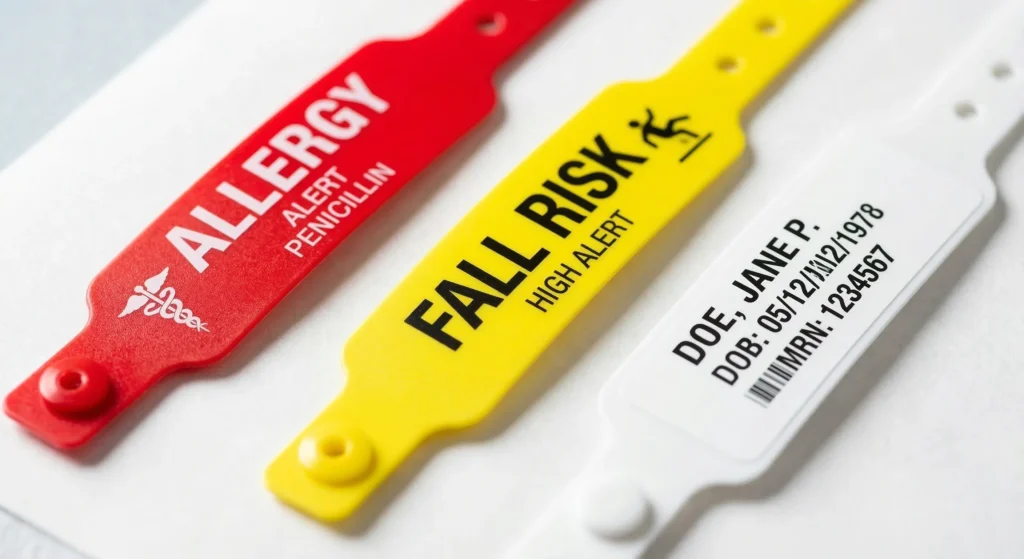
Complete Guide to Hospital Wristband Color Codes: What Each Color Represents
Ever stared at those brightly colored bands on your wrist during a hospital visit and wondered what they actually mean? You’re not alone. It’s completely natural to feel a bit anxious when medical staff start attaching neon strips to your arm. As someone who oversees patient safety identification systems, I understand the worry. Let’s skip the confusing clinical talk. Here is exactly how we use hospital wristband color codes to communicate critical information and ensure the prevention of medical errors.
Hospital Wristband Color Codes Quick Reference
Think of medical alert color coding as a silent, immediate language for your care team. When minutes matter, these visual cues speak volumes before a doctor or nurse even opens your chart.
Color Meaning Cheat Sheet
| Band Color | Clinical Meaning | Immediate Takeaway |
|---|---|---|
| Red | Allergy Alert | Patient has known, documented allergies (medication, food, etc.). |
| Yellow | Fall Risk Indicator | Patient requires physical assistance when moving or walking. |
| Purple | DNR Protocols | Do Not Resuscitate (DNR) medical orders are legally in place. |
| Pink | Limb Alert | Restricted extremity; no blood pressure cuffs or IVs on this arm. |
| Green | Latex Allergy | Care team must strictly avoid using all latex medical products. |
Action Required by Medical Staff
When my team sees these specific colors, it instantly dictates our exact next steps. A colored band is never just a suggestion—it is a strict, non-negotiable safety protocol.
- The Mandatory Pause: Before administering any medication, drawing blood, or initiating movement, medical staff must physically and visually verify the wristband.
- Digital Verification: Visual cues are the first line of defense, but hard data backs them up. Staff will scan your band to cross-reference the physical color code with your digital chart. By utilizing highly reliable platforms like LinkWin, we ensure the printed alert on your wrist perfectly and instantly matches your live medical record.
- Immediate Precaution Implementation: The action is immediate. If we see Yellow, we automatically bring a walker or support staff before you stand. If we see Pink, we immediately switch to the opposite arm for your blood draw without needing to ask.
Standardized Hospital Color Codes Detailed
When you walk into a hospital, confusion is the last thing you need. That’s why standardized color codes are critical. They aren’t just random choices; they are a universal language designed to keep patients safe without needing to check a chart every five seconds. Here is a breakdown of the standard colors you will see in most facilities following AHA standardized wristband colors guidelines.
Red: Allergy Alert
Red means stop, and in a hospital setting, it means stop and check. A red wristband signals that a patient has an allergy. This could be anything from a specific medication to food or environmental factors. It is a massive visual cue for nurses and doctors to double-check the patient’s file before administering any drugs or meals. It’s a simple step that prevents severe medical errors.
Yellow: Fall Risk Indicator
We use yellow bands to identify patients who need extra assistance moving around. This is the Fall Risk Indicator. Patients wearing this might be elderly, dizzy from medication, or recovering from surgery that affects their balance. When staff see yellow, they know they cannot let that patient walk to the restroom alone. It’s a proactive measure to prevent accidents before they happen.
Purple: Do Not Resuscitate (DNR) Protocols
The purple wristband carries a heavy but necessary message. It indicates a patient’s end-of-life decision regarding DNR wristband protocols. If a patient with a purple band goes into cardiac arrest, the medical team knows to respect their wish not to be resuscitated. This color ensures that in a high-stress emergency, the patient’s specific legal and medical wishes are honored immediately without confusion.
Pink: Restricted Extremity or Limb Alert
A pink band is a “Limb Alert.” It tells the medical team to be careful with a specific arm or leg. This is common for patients who have had a mastectomy, have a fistula for dialysis, or have an IV line that shouldn’t be disturbed. The limb alert bracelet meaning is clear: do not use this extremity for blood pressure cuffs or blood draws. It protects the patient from unnecessary pain and complications.
Green: Latex Allergy and Safety Cues
While red covers general allergies, green is often specifically reserved for a latex allergy hospital band. Since latex is everywhere in a hospital—from gloves to medical tubing—knowing a patient is allergic is vital. In some systems, green might also signify other safety cues, but its primary job is usually to warn staff to use latex-free equipment to avoid triggering a potentially life-threatening reaction.
Standardization & Alert Fatigue
AHA Standardized Wristband Colors
I’ve seen firsthand how a unified system saves lives. Before standardization, a green band at one hospital might mean an allergy, while at a neighboring facility, it meant something entirely different. To fix this, the industry adopted AHA standardized wristband colors in 2008. By locking in universal meanings for conditions like allergies and DNRs, this shift became a critical foundation for modern patient safety identification systems and a massive leap forward in the prevention of medical errors.
State Variations in Medical Alert Color Coding
While the AHA guidelines laid the groundwork, 100% uniformity isn’t a global or even national reality just yet.
- Regional Rules: We still see state variations in medical alert color coding.
- Facility Preferences: Some local health networks enforce specific additional colors for their own internal tracking.
- The Takeaway: Medical staff must always double-check local protocols, as hospital wristband color codes can still fluctuate slightly depending on the specific state or hospital network you are working in.
The Risks of Patient Alert Fatigue
Adding a wristband for every minor detail sounds safe, but it actually creates a dangerous working environment. When a patient’s wrist is covered in four or five different bands, we run into alert fatigue.
- Visual Overload: Too many colors blend together, causing busy nurses and doctors to subconsciously ignore the bands.
- Complacency: If almost every patient triggers a visual alert, the true high-risk warnings get lost in the noise.
- Best Practice: Stick to the essentials. Facilities should rely on the core standards outlined in a Complete Guide to Hospital Wristband Color Codes: What Each Color Represents. Limiting the number of bands ensures that when a nurse sees a red or purple alert, it immediately demands attention.
Modern Patient ID Technology
While a complete guide to hospital wristband color codes helps staff quickly identify visual alerts, modern patient safety identification systems rely heavily on advanced hardware. At LinkWin, we build wristbands that bridge the gap between simple visual cues and secure digital accuracy.
Thermal Medical Wristband Printing
We have fully transitioned to thermal medical wristband printing for our products. Traditional ink smears and fades over time, but thermal printing uses heat to embed patient data directly into the band material. This guarantees that critical details and your hospital wristband color codes remain perfectly legible from admission to discharge, completely resisting water, alcohol, and harsh hand sanitizers.
Barcodes and the Five Rights
A reliable barcode scan is the ultimate safeguard against medical errors. By scanning the patient’s wristband, medical staff directly enforce the “Five Rights” of medication administration:
- Right Patient
- Right Medication
- Right Dose
- Right Route
- Right Time
RFID Patient Tracking Wristbands
For advanced facility security, we utilize RFID patient tracking wristbands. These smart bands contain tiny embedded chips that transmit real-time location data through the hospital’s network. This technology is vital for monitoring vulnerable patients, preventing wandering, and tracking patient flow without relying exclusively on visual checks.
LinkWin EHR Integration
Hardware is useless without the right software backing it up. Our LinkWin systems are built for seamless Electronic Health Record (EHR) integration. When a doctor updates a chart or adds a new allergy alert in the EHR, the LinkWin system synchronizes immediately. This creates a closed-loop system that guarantees strict patient identification compliance right at the bedside.
| ID Technology | Core Advantage | Healthcare Application |
|---|---|---|
| Thermal Printing | Smudge-proof durability | Long-term patient stays |
| Barcodes | Instant data verification | Medication administration |
| RFID Chips | Real-time location tracking | High-risk ward security |
| EHR Sync | Centralized accurate data | Hospital-wide system updates |
Frequently Asked Questions
When you’re navigating a hospital stay, those colorful bands on your wrist can raise a lot of questions. Here are the answers to the most common concerns patients have about hospital wristband color codes.
Can I remove an uncomfortable hospital wristband?
Short answer: No.
I know they can be itchy, sweaty, or just plain annoying, especially if you are staying for several days. However, that band is your primary link to patient safety identification systems. It is the only way nurses and doctors can instantly verify who you are before administering medication or performing a procedure.
If the band is too tight or causing skin irritation:
- Don’t cut it off yourself. This can delay your care while staff scramble to re-admit you into the system.
- Ask a nurse to replace it. They can print a new one using thermal medical wristband printing that might be softer or adjusted for a better fit.
- Check the material. Some hospitals use stiff Tyvek, while others might have softer options. It never hurts to ask.
What if I have an unlisted hospital band color?
While the AHA has pushed for standardized hospital color codes, not every facility follows the exact same playbook. You might see a blue, orange, or white band that isn’t on the standard cheat sheet.
- Internal Protocols: Some hospitals use specific colors for internal tracking, like “isolation required” or specific ward designations.
- Custom Alerts: It could indicate a specific medical trial or a dietary restriction.
- Ask for Clarification: If you don’t know what a band means, ask your care team. It is your right to understand your medical treatment.
Do newborn babies have different color codes?
Yes, the maternity ward often operates with its own set of rules to ensure the highest security.
- Matching Bands: The most critical band is the one that links the mother to the baby. These often have matching serial numbers or barcodes to prevent any mix-ups.
- Security Tags: You will often see RFID patient tracking wristbands or “Hugs” tags on infants. These trigger alarms if the baby is moved too close to an exit.
- Gender Indicators: While less common now due to privacy, some hospitals still use pink or blue stripes on the admission bands to denote sex at birth.
