
Subtotal ¥0.00
Patient wristband information and best practice guidelines covering identifiers color codes barcodes RFID and safety compliance
The Critical Role of Positive Patient Identification
Have you ever worried about the devastating consequences of administering medication to the wrong person? How often do manual identification checks fail during a hectic hospital shift? When facilities ask what information should be included on a patient’s wristband: best practice guidelines dictate that precision is absolutely non-negotiable.
Patient misidentification is a leading cause of preventable, and often catastrophic, medical errors. For decades, hospitals relied heavily on visual checks and verbal confirmations. However, these outdated methods are highly vulnerable to human error, cognitive overload, and fatigue, leaving patients at serious risk.
Transitioning to Data-Driven Patient Identification
Modern healthcare demands a definitive shift from manual verification to automated, data-driven identification systems. Implementing strict Positive Patient Identification (PPID) requires clinical workflows to evolve:
- Eliminating Visual Guesswork: Moving away from quick glances and relying on definitive barcode and data scans.
- Seamless EHR Integration: Ensuring the physical ID connects flawlessly and instantly to Electronic Health Records.
- Actionable Data: Displaying precise, standardized clinical data right at the bedside.
LinkWin Solutions for Zero-Error Safety
As the creators of LinkWin wristband solutions, we engineer our products to eliminate identification failures directly at the point of care. We know that accurate patient wristband information is the most critical link between a patient and their prescribed treatment. Our wristband solutions are specifically designed to support zero-error patient safety initiatives, providing highly legible, scan-ready, and durable identification that healthcare providers can trust without hesitation.
Patient Wristband Information: Core Data Elements
When we map out patient wristband information, getting the basics right is non-negotiable for patient safety. We adhere strictly to the Joint Commission patient identifier standards to ensure every band serves as an absolute source of truth in clinical settings.
The Two Patient Identifier Rule
I always remind healthcare teams that positive patient identification hinges on the two patient identifier rule. You must use at least two distinct, permanent data points to verify exactly who you are treating before any procedure.
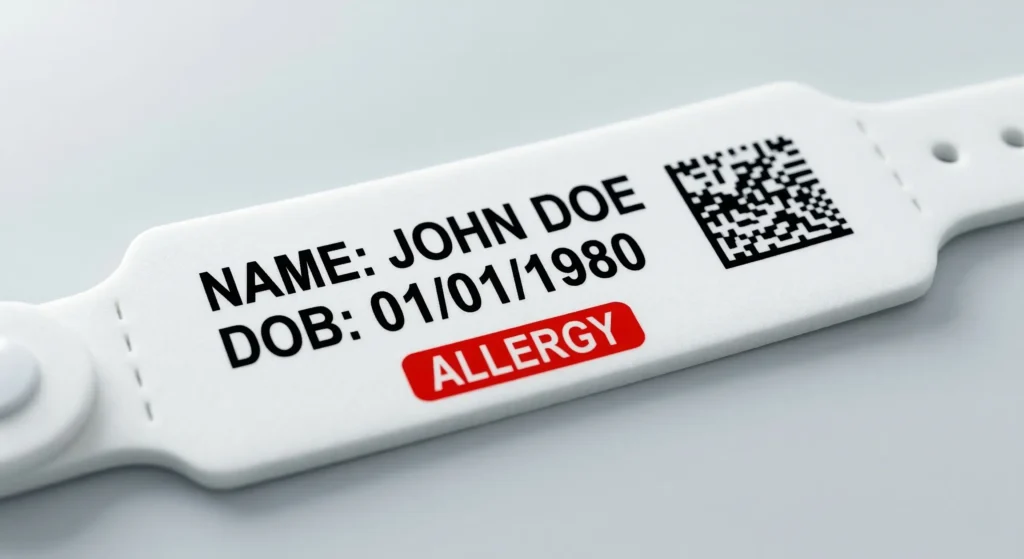
- Primary Identifiers: Full Legal Name and Date of Birth (DOB). These must be the largest, most prominent text on the band.
- Secondary Identifiers: Medical Record Number (MRN). We optimize the medical record number MRN formats to be easily scannable and perfectly readable right beneath the primary data.
Identifiers to Strictly Avoid
Never tie a patient’s identity to their location or physical traits. Using temporary markers is a direct path to critical medical errors. Do not use:
- Room Numbers: Patients move constantly; rooms change.
- Bed Numbers: Temporary and highly unreliable.
- Physical Descriptions: Completely subjective and prone to bias.
Demographic and Clinical Data Allocation
Beyond the mandatory identifiers, a well-designed wristband organizes extra clinical data cleanly without overcrowding the core information. Here is how we recommend allocating the remaining space on the band:
| Data Element | Recommended Placement |
|---|---|
| Primary Physician Name | Placed just below the MRN for quick clinical reference. |
| Admission Date | Located at the bottom margin to help staff track the length of stay. |
| Sex | Positioned directly alongside the DOB for a complete demographic profile. |
Standardized Color-Coded Safety Alerts
When we talk about patient safety, visual cues are just as critical as the data printed on the band. In a busy ward, a nurse needs to know instantly if a patient is at risk of falling or has a severe allergy before they even scan a barcode. This is where standardized color-coding saves lives.
We rely on universal healthcare color meanings to create an immediate visual language that transcends language barriers. While standards can vary slightly by region, the American Hospital Association (AHA) and many global bodies have aligned on these core alerts:
- Red (Allergy): This is the universal “STOP” sign. It signals that the patient has a drug, food, or environmental allergy. It prompts the clinician to double-check the chart before administering anything.
- Yellow (Fall Risk): Used for patients who are unsteady, elderly, or on medication that causes dizziness. It tells staff they need assistance when moving.
- Purple (DNR): Indicates a “Do Not Resuscitate” order. This is a critical end-of-life directive that must be immediately visible during an emergency.
- Green (Latex Allergy): While less common now due to latex-free environments, this is still a vital alert in many surgical settings.
The Importance of State and National Standardization
The danger lies in inconsistency. If one hospital uses yellow for “Fall Risk” and a neighboring clinic uses yellow for “DNR,” a traveling nurse or a transferred patient could face a catastrophic error. Standardization prevents clinician confusion.
We always recommend using fully colored wristbands rather than applying small color-coded stickers to a standard white band. Stickers can fall off, be overlooked, or get covered by a blanket. A solid red allergy wristband or a bright yellow fall risk identifier is impossible to ignore. By adopting these standardized, high-visibility bands, facilities ensure that critical safety information is communicated loud and clear, every single time.
Advancing Patient Safety with Barcode and RFID Technology
We’ve moved far beyond simple text on a plastic band. To truly secure patient safety, modern identification relies on scannable data that connects directly to your hospital’s digital brain.
1D vs. 2D Barcodes in Clinical Workflows
Space on a wristband is prime real estate. While traditional linear (1D) barcodes have been the standard for years, many facilities are upgrading to 2D barcode patient ID bands (like QR codes or Data Matrix).
- Space Efficiency: A 2D barcode holds much more data in a fraction of the space, leaving room for essential human-readable text.
- Scanning Reliability: They are omni-directional, meaning nurses don’t have to twist a patient’s arm into an uncomfortable position to get a beep. They scan instantly, even if the band is slightly curved or wrinkled.
Bedside Medication Verification (BMV) and EHR Sync
The barcode is the key that unlocks the Electronic Health Records (EHR) integration. When a nurse scans the wristband before administering a drug, they are performing Bedside Medication Verification (BMV). This simple “beep” confirms the “Five Rights” of medication administration instantly:
- Right Patient
- Right Drug
- Right Dose
- Right Route
- Right Time
If the data on the wristband doesn’t match the physician’s order in the EHR, the system throws up a hard stop alert, preventing a potential error before it happens.
RFID Integration for Modern Hospitals
For facilities aiming for the next level of automation, healthcare RFID tracking wristbands are changing the game. Unlike barcodes that require a direct line of sight, RFID (Radio Frequency Identification) allows for passive tracking.
- Real-Time Location: We can instantly locate wandering patients (like those with dementia) or track patient flow through the ER to identify bottlenecks.
- Automated Workflow: As a patient moves from their room to radiology, the system updates their status automatically without manual data entry, streamlining the entire care journey.
Regulatory Compliance and Patient Privacy
When we talk about what goes on a wristband, we aren’t just discussing logistics; we are navigating a minefield of legal requirements. Balancing immediate clinical accessibility with strict privacy laws is a challenge every hospital administrator faces.
Maintaining HIPAA Compliance on Physical ID Bands
The Health Insurance Portability and Accountability Act (HIPAA) mandates the protection of Protected Health Information (PHI). While a wristband needs to be informative, it cannot be a billboard for sensitive personal data. The goal is to provide enough information for positive patient identification (PPID) without exposing the patient’s entire medical history to anyone walking down the hallway.
We recommend a “less is more” approach for human-readable text, while leveraging technology for the heavy lifting:
- Visible Data: Stick to the essentials required for the Two-Identifier Rule (Name and DOB).
- Hidden Data: Use 2D barcode patient ID bands to encode sensitive clinical details like specific diagnosis codes or social security numbers. This ensures that deep data is only accessible to authorized staff scanning the band with a secure device.
- Privacy Filters: Avoid printing full social security numbers or detailed financial class information directly on the band.
Meeting National Patient Safety Goals (NPSG)
Compliance goes beyond privacy; it is about meeting the rigorous standards set by accreditation bodies. The Joint Commission’s National Patient Safety Goals identification standards require hospitals to improve the accuracy of patient identification.
Your wristband system is the first line of defense in this audit trail. To meet NPSG requirements, the wristband must serve as the anchor for all documentation:
- Audit Trails: Every scan of a barcode on the wristband creates a digital timestamp. This proves that the nurse was at the bedside and verified the patient before administering medication or drawing blood.
- Standardized Formats: Using consistent medical record number (MRN) formats across all bands ensures that there are no discrepancies between the physical band and the electronic health record (EHR).
- Zero-Error Tolerance: Auditors look for systems that eliminate workarounds. If a wristband is faded or unreadable, compliance is broken. High-quality thermal printing ensures the data remains legible for the entire stay, keeping you audit-ready 24/7.
Physical Specifications for Medical-Grade Wristbands
When we talk about patient wristband information, we often focus on the data printed on the band. However, the physical medium itself is just as critical. A wristband that falls off, fades, or causes skin irritation is useless, no matter how accurate the barcode is. We engineer our LinkWin wristbands to withstand the rigorous demands of a hospital environment while ensuring the patient remains comfortable.
Durability in Harsh Clinical Environments
Hospitals are tough environments for printed materials. A standard office label won’t survive a single shift. Medical-grade wristbands must be resistant to a wide array of fluids and chemicals commonly found at the bedside. If the ink smears or the material degrades, positive patient identification (PPID) fails.
Our wristbands are tested to resist:
- Water and Moisture: Essential for daily hygiene and showers.
- Alcohol and Hand Sanitizers: Constant exposure during staff hand hygiene protocols.
- Betadine and Iodine: Common surgical preps that stain and degrade lesser materials.
- Soaps and Mild Solvents: Routine cleaning agents used in patient care.
Patient Comfort and Security
Security and comfort often seem like opposing goals, but in healthcare, they must coexist. The wristband is the one item a patient wears 24/7, so it cannot be a source of injury or irritation. Simultaneously, it must be impossible to transfer between patients to maintain the integrity of the Two Patient Identifier Rule.
Key Material Features:
| Feature | Benefit |
|---|---|
| Hypoallergenic & Latex-Free | Prevents allergic reactions and contact dermatitis, safe for sensitive skin (including neonates). |
| Soft, Flexible Edges | Eliminates sharp corners that could scratch or cut the patient’s skin. |
| Tamper-Proof Closures | Uses a destructive clasp or adhesive that shreds if removal is attempted, preventing unauthorized transfer. |
| Antimicrobial Coating | Reduces the risk of the wristband becoming a vector for hospital-acquired infections (HAIs). |
By prioritizing these physical specifications, we ensure that the wristband remains a reliable tool for safety from admission to discharge, without compromising the patient experience.
Implementing Best Practices and Staff Protocols
Even with the most advanced barcode technology or the most durable wristbands, the system only works if your team knows how to use it. Technology supports safety, but human protocol enforces it. We need to embed patient wristband information checks into every single interaction, turning verification into a reflex rather than a chore.
The Patient Journey: Critical Verification Checkpoints
Patient identification isn’t a “one and done” task at the front desk. It is a continuous loop that follows the patient throughout their entire stay. We recommend establishing hard stops for verification at these specific moments:
- Admission: This is where the Positive Patient Identification (PPID) chain begins. The initial banding must be double-checked against government ID and admission orders.
- Blood Draws & Specimen Collection: Mislabeling here is disastrous. The wristband must be scanned before the sample is collected, not after.
- Diagnostic Imaging: Before a patient enters an MRI or CT scanner, the technician must verify the MRN and name on the band to ensure the right scan is happening to the right person.
- Medication Administration: This is the classic Bedside Medication Verification (BMV) moment. Scan the patient, scan the med.
- Discharge: The final check ensures the patient leaves with the correct discharge instructions and prescriptions.
Staff Training: Enforcing the “Two, It’s You!” Routine
We can’t rely on visual recognition alone. A tired nurse at 3 AM might mistake one patient for another if they are just glancing at a face. We train staff on the “Two, It’s You!” protocol.
This involves a verbal and visual confirmation using the two patient identifier rule:
- Ask: “Can you please state your full name and date of birth?”
- Check: Compare their answer directly against the patient wristband information.
- Scan: Use the barcode scanner to confirm the data matches the Electronic Health Records (EHR).
If a patient is non-verbal or sedated, the process shifts entirely to the wristband scan and checking the medical record number (MRN) against the orders. By standardizing this workflow, we remove the guesswork and drastically reduce the risk of preventable errors.
