
Subtotal ¥0.00
LinkWin START Triage System guide explains RPM steps color codes and JumpSTART for fast accurate mass casualty response
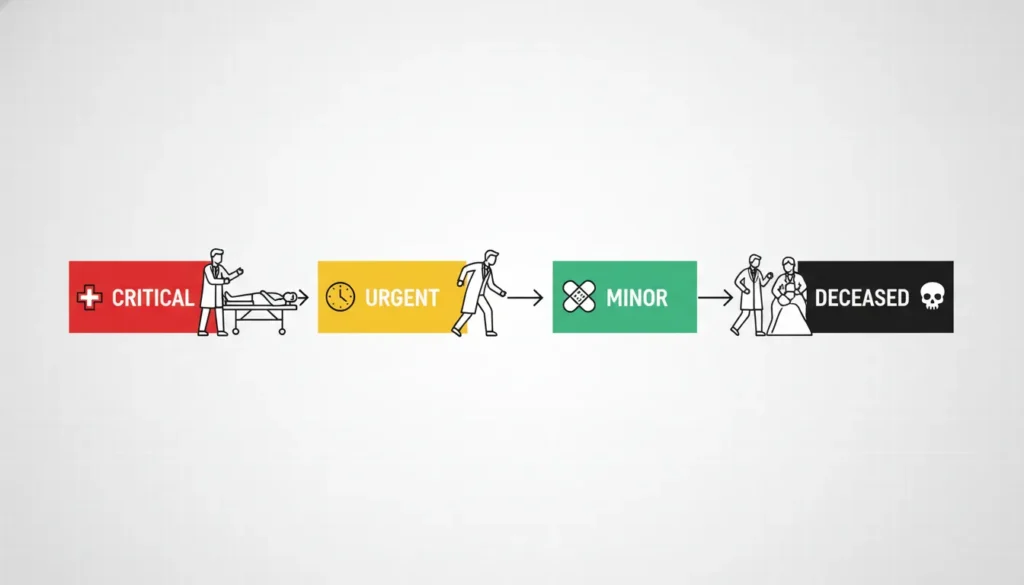
How START Works: The Core Logic of Triage
When we arrive at a disaster scene, chaos is the default state. The START Triage System—standing for Simple Triage and Rapid Treatment—is our primary blueprint for restoring order. It serves as the standard for Mass Casualty Incident (MCI) protocols across the US, designed to do the greatest good for the greatest number of people. We do not use this system to diagnose specific medical conditions; rather, we use it to rapidly sort victims based on the severity of their injuries and their likelihood of survival.
Our objective is clear: identify who needs immediate intervention and who can wait. By removing emotion from the decision-making process, we rely on objective physiological checks. This systematic approach allows first responder disaster training to kick in, ensuring that limited medical resources are allocated efficiently rather than wasted on those who are already beyond help or those with minor injuries.
The 60-Second Rule: Speed is Survival
In a mass casualty scenario, time is the ultimate enemy. We operate under a strict 60-second rule for every victim encountered. I cannot emphasize this enough: never spend more than one minute assessing a single patient. This rapid pace is critical to preserving the Golden hour in trauma, ensuring that viable patients receive transport and surgical intervention before their physiological reserves collapse.
During this brief window, we perform a focused pre-hospital patient assessment. We are not conducting a full secondary survey; we are checking vital signs and responsiveness. If we delay on one patient, we risk the lives of three others waiting for help. The mindset is rigid: assess, tag, and move immediately to the next person. Speed is not just a metric here; it is the defining factor of survival.
Correction of Life Threats: Airway and Hemorrhage Only
During the initial triage sweep, we strictly limit medical interventions. We do not splint fractures, bandage minor cuts, or perform CPR. We stop only to correct two specific, immediate life threats: blocked airways and uncontrolled hemorrhage.
- Airway Management: If a patient is not breathing, we manually position the head to open the airway. If breathing resumes, they are tagged Immediate (Red). If they remain apneic, we move on.
- Hemorrhage Control: We address massive, spurting bleeding immediately. This involves the rapid application of tourniquets or pressure dressings.
This adherence to rapid treatment protocols ensures we stop the dying process for the most critical patients without getting bogged down in time-consuming care. Once the airway is open or the bleeding is stopped, we tag the patient and proceed. Airway management in triage and bleeding control are the only exceptions to the “assess and move” rule.
Decoding the Four Triage Color Codes
In the chaos of a Mass Casualty Incident (MCI), verbal communication often fails. We rely on a standardized, visual language to categorize patients instantly based on the severity of their injuries. Triage Tags color coding is the backbone of this process, turning a disorganized scene into a structured environment where we can allocate limited resources effectively. We don’t diagnose specific injuries here; we assess physiological stability to decide who moves first.
Green Tag: Identifying the Walking Wounded
The quickest way to clear the confusion is to identify the walking wounded. These are patients with minor injuries—cuts, bruises, or simple fractures—who are physically capable of following commands and moving themselves.
- Action: I shout a clear command: “If you can hear me and walk, move to the area behind the ambulance.”
- Result: Anyone who stands up and moves gets a Green tag.
- Priority: Lowest. They are stable and can wait while we focus on life threats.
Yellow Tag: Managing Delayed but Serious Injuries
Patients assigned a Yellow tag fall into the Delayed category. They have significant injuries and cannot walk, but their vital signs are stable based on our rapid assessment.
- Condition: They pass the RPM Mnemonic check (Respirations are normal, Perfusion/pulse is present, Mental Status is alert).
- Examples: A victim with a broken leg who is talking to you and has a strong radial pulse.
- Strategy: These patients need hospital care, but they aren’t currently dying. We monitor them, but they wait until the Red tags are transported.
Red Tag: Prioritizing Immediate Life Threats
This is the core of the START Triage System. A Red tag signals an Immediate need for intervention. These patients have life-threatening conditions that are treatable if we act fast.
- Criteria: They have issues with Airway, Breathing (too fast or too slow), or Circulation (absent radial pulse or slow capillary refill test).
- Urgency: We treat these patients first. This is where pre-hospital patient assessment determines survival during the Golden hour in trauma.
- Intervention: We might reposition an airway or apply a tourniquet, tag them Red, and signal for immediate transport.
Black Tag: Protocols for Expectant and Deceased
Assigning a Black tag is the hardest decision in disaster scene management. This category is for victims who are deceased or have injuries so catastrophic that survival is impossible with the resources on hand.
- Protocol: If a patient is not breathing, I open their airway manually.
- Decision: If they start breathing, they are Red. If they remain apneic (not breathing) after the airway is opened, they are tagged Black.
- Reality: We do not perform CPR in an MCI. We must move on to save those who are still fighting for their lives.
Mastering the RPM Mnemonic Algorithm
When I’m in the middle of a Mass Casualty Incident (MCI), there is no time for second-guessing. The chaos requires a rigid structure to ensure we save the most lives possible. That structure is the RPM Mnemonic. This is the heartbeat of the START Triage System. It stands for Respirations, Perfusion, and Mental Status.
I use this algorithm to make rapid assessments—usually in under 60 seconds per patient. The logic is sequential: I only move to the next letter if the patient passes the current one. If they fail at any point, I tag them Immediate (Red) and move to the next victim.
R is for Respirations: Assessing Breathing Rates
The first step is checking if the patient is breathing. This is the most critical indicator of survival.
- Not Breathing: I manually open the airway. If breathing starts, I tag them Red. If they still do not breathe, I tag them Black (Deceased).
- Breathing: I count the respiratory rate.
- Above 30 breaths per minute: This indicates shock or severe distress. I tag Red.
- Below 30 breaths per minute: The patient is stable enough to proceed to the next step, Perfusion.
P is for Perfusion: Checking Circulation and Pulse
Once I’ve confirmed breathing is stable, I check the circulatory system. I need to know if oxygenated blood is reaching the extremities. The standard method here is the capillary refill test.
I pinch a fingernail or the skin on the palm until it blanches white, then release it.
- Refill takes more than 2 seconds: This suggests delayed capillary refill and poor perfusion. I check for major bleeding, stop it, and tag Red.
- Refill takes less than 2 seconds: Circulation is adequate. I move on to Mental Status.
If it is dark or the patient is cold, the capillary refill test might be unreliable. In those cases, I check the radial pulse. If the radial pulse is absent, I tag Red.
M is for Mental Status: Testing Command Follow-Through
The final check in the RPM sequence assesses neurological function. I am not performing a complex exam; I simply need to know if the brain is oxygenated enough to process instructions.
I give a simple command, such as “Squeeze my hand” or “Close your eyes.”
- Cannot follow commands: If the patient is unresponsive or confused, it indicates a serious head injury or shock. I tag Red.
- Follows commands: If they can understand and act, and they have passed the R and P checks, their condition is serious but not immediately life-threatening. I tag them Yellow (Delayed).
Step-by-Step Field Execution Guide
When I arrive at a chaotic scene, I need a plan that sticks. We cannot rely on guesswork when adrenaline is pumping. Implementing the START Triage System requires a disciplined, three-step approach to bring order to a Mass Casualty Incident (MCI). This process ensures we maximize survival rates by focusing our limited resources where they matter most.
Step 1: Clearing the Scene with Voice Commands
The first move is always to reduce the noise. I need to clear out anyone who isn’t critically injured to get a better view of the situation. I use a loud, authoritative voice—or a megaphone if available—to issue a simple, direct command to the crowd.
“If you can hear my voice and you are able to walk, move to the designated area immediately.”
This instantly identifies the walking wounded. These patients are automatically categorized as Green Tag (Minor). By moving them away from the immediate danger zone, I clear the workspace so I can focus on those who cannot move. This simple action effectively separates the critical patients from the non-critical, often reducing the immediate patient load by half.
Step 2: The Systematic Sweep Strategy
Once the minor injuries are cleared, I do not just run to the screaming patients. That is a common trap. I use a systematic sweep pattern to ensure effective disaster scene management. Randomly running between victims guarantees that quiet, unconscious patients will be missed.
- Start Point: I pick a specific corner or landmark to anchor the search.
- Pattern: I move in a strict grid or spiral pattern, checking every person in my path.
- Discipline: I never bypass a quiet patient to get to a loud one; the quiet ones are often the most critical.
I stick to the route. If I start jumping around, I lose track of who has been assessed. Every victim gets a rapid assessment as I encounter them in the sweep to ensure total coverage.
Step 3: Tagging, Treating, and Moving On
This is where the RPM Mnemonic drives the decision. I stop at a patient, assess Respiration, Perfusion, and Mental Status, and apply the correct Triage Tags color coding. My time limit is 30 seconds or less per patient.
- Red Tag (Immediate): If they have airway issues or uncontrolled bleeding, I intervene instantly. I open the airway or apply a tourniquet. These are the only treatments allowed during triage.
- Yellow Tag (Delayed): They are serious but stable and can wait for transport.
- Black Tag (Deceased): If there is no respiration after airway repositioning, I move on.
I do not perform CPR. I do not splint broken bones. The goal is rapid treatment protocols for immediate life threats only. Once the tag is attached to the victim, I move immediately to the next person. Speed is the only way to save the most lives during the Golden hour in trauma.
JumpSTART: Pediatric Triage Differences
When I arrive at a disaster scene involving families or schools, standard adult protocols often fail. Children are not simply small adults; their physiology requires a specialized approach known as JumpSTART pediatric triage. This system is designed specifically for victims who appear to be between the ages of one and eight years old. Applying adult metrics to a child can lead to dangerous over-triage or fatal under-triage, so understanding the shift in the RPM Mnemonic is critical for effective disaster scene management.
Adult vs. Child: Key Physiological Variations
The biological baselines for children differ significantly from adults, particularly regarding respiratory rates and mental status. In an MCI protocol, I have to adjust my thresholds for what constitutes an immediate life threat.
- Respirations (R): A child breathes faster than an adult. While an adult rate over 30 is a red flag, for a child, the danger zone is usually defined as fewer than 15 or more than 45 breaths per minute.
- Perfusion (P): We still check the capillary refill test, but since children compensate for shock differently, checking a peripheral pulse is often more reliable than refill time alone in cold environments.
- Mental Status (M): I cannot expect a terrified 3-year-old to follow the command “squeeze my hand.” Instead of the standard command-following test, JumpSTART uses the AVPU scale (Alert, Verbal, Pain, Unresponsive). If the child is alert or responds to voice or pain appropriately, they pass; if they are unresponsive or have an inappropriate posturing response to pain, they are tagged immediate.
The Rescue Breath Protocol for Children
The most critical deviation from the standard START system is how we handle apnea (not breathing). In adult triage, if I open the airway and the patient does not breathe, I tag them Black (deceased) and move on. In pediatric trauma, respiratory arrest often precedes cardiac arrest. The heart may still be beating even if the lungs have stopped.
Therefore, JumpSTART includes a specific rescue breath step:
- Assess Breathing: If the child is not breathing, I open the airway using a head-tilt/chin-lift (or jaw thrust).
- Check Pulse: If breathing does not resume, I immediately check for a peripheral pulse.
- Deliver Breaths: If there is no breathing but there is a pulse, I give 5 rescue breaths (lasting about 15 seconds).
- Re-evaluate: If the child starts breathing on their own, they are tagged Red (Immediate). If they remain apneic after the breaths, only then are they tagged Black.
Comparison of Apnea Protocols in Triage
| Feature | START (Adult) | JumpSTART (Pediatric) |
|---|---|---|
| Primary Cause of Death | Cardiac Arrest / Trauma | Respiratory Failure / Hypoxia |
| Action if Apneic | Open Airway | Open Airway |
| If Still Apneic | Tag Black (Deceased) | Check Pulse |
| If Pulse Present | Tag Black (Deceased) | Give 5 Rescue Breaths |
| Outcome Goal | Maximize resources for survivors | Reverse respiratory arrest early |
Avoiding Common Triage Pitfalls in the START Triage System
Even with the best First responder disaster training, chaos can cloud judgment. When running a Mass Casualty Incident (MCI), sticking strictly to the protocol is the only way to save the most lives. We have to be disciplined to avoid fatal errors that compromise the entire operation.
The Dangers of Over-triage and Under-triage
Getting the Triage Tags color coding wrong has serious consequences. It is a delicate balance that affects resource allocation:
- Over-triage: Tagging a minor injury as “Immediate” (Red) floods the system. It wastes critical resources on patients who could wait, potentially dooming those with actual life threats.
- Under-triage: This is often fatal. Missing a subtle sign of shock or airway compromise means a critical patient is marked “Delayed” (Yellow) or “Minor” (Green) and doesn’t get the rapid treatment protocols they need.
We must rely on the objective RPM Mnemonic—Respirations, Perfusion, Mental Status—rather than emotional reactions to visible but non-fatal injuries.
Fighting Tunnel Vision in Mass Casualty Incidents
The urge to stop and fix everything is natural, but it is dangerous in disaster scene management. Tunnel vision occurs when a responder focuses entirely on one patient’s gruesome injury, forgetting the dozen others waiting behind them.
Remember, during the initial sweep, we are sorting, not curing. If you spend 10 minutes splinting a leg, you have failed the START Triage System logic. Correct the airway, stop massive bleeding, tag them, and move on. Speed is survival.
The Importance of Re-Triage at Collection Points
A patient’s condition is never static. Shock progresses, and adrenaline wears off. The initial tag is just a snapshot in time. Re-triage is essential once patients reach the treatment area or collection point.
- Monitor Changes: A “Walking Wounded” patient might lose consciousness, requiring an upgrade to Red.
- Verify Resources: Before transport, ensure the Emergency Medical Services (EMS) algorithms match the current patient status.
Continuous reassessment prevents patients from deteriorating unnoticed while waiting for transport.
Frequently Asked Questions About START Triage
When dealing with Mass Casualty Incident (MCI) protocols, clarity is everything. I often see confusion regarding specific rules when resources are scarce. Here are the answers to the most common questions regarding the START Triage System to ensure you make the right call under pressure.
What is the main difference between START and JumpSTART?
The primary difference is the patient’s age and physiology. The standard START algorithm is built for adults, while JumpSTART pediatric triage is modified for children (usually under 8 years old or under 100 lbs).
- Respiratory Rates: Adults are assessed against a limit of 30 breaths per minute. Children have faster metabolisms, so JumpSTART uses a range of 15 to 45 breaths per minute.
- The Apnea Rule: In adult START, if a patient isn’t breathing after you open their airway, they are tagged Black. In JumpSTART, if a child is apneic (not breathing) but has a pulse, we deliver 5 rescue breaths. If they start breathing, they are an Immediate (Red); if not, only then are they tagged Black.
Can you perform CPR during START triage?
No. This is often the hardest adjustment for those trained in standard First Aid/CPR. During the initial triage phase of a disaster, you do not stop to perform CPR.
If a patient has no pulse or fails to breathe after airway repositioning (and rescue breaths for kids), they are tagged Black. In a mass casualty scenario, time and resources are limited. Stopping to perform CPR on one cardiac arrest victim prevents you from assessing and treating multiple salvageable patients with immediate life threats, such as severe hemorrhage or tension pneumothorax.
How long should each patient assessment take during an MCI?
Speed is survival. You should aim to complete the RPM Mnemonic assessment and apply the correct Triage Tags color coding in 30 seconds or less.
- Do not diagnose: You are sorting, not curing.
- Limit interventions: Only correct the airway or stop massive bleeding.
- Keep moving: If you are unsure between two categories, always tag up (choose the higher priority) and move to the next victim.
Following these rapid treatment protocols ensures you clear the scene efficiently during the “Golden Hour” of trauma.
