
Subtotal ¥0.00
Learn Two Identifier Rules in patient identification, cut errors, meet NPSG 010101 and implement safe barcode workflows
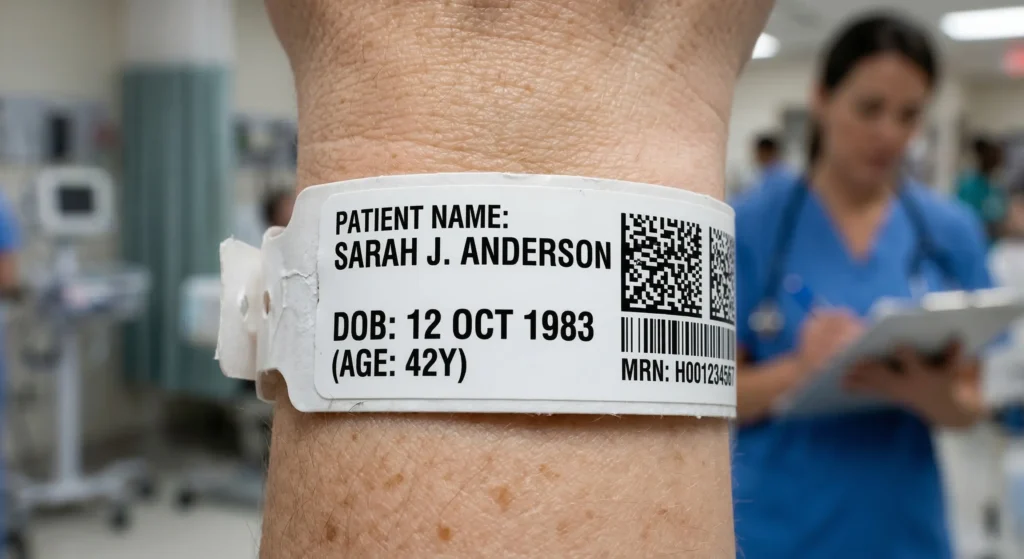
Decoding the “Two Identifier Rule” (NPSG.01.01.01)
Have you ever walked into a patient’s room and felt that split-second of doubt—is this definitely the right person? In healthcare, that doubt is dangerous. The cornerstone of preventing identity errors lies in understanding National Patient Safety Goal 01.01.01.
What the Rule Actually Says
The mandate from the Joint Commission is straightforward but non-negotiable: reliably identify the individual as the person for whom the service or treatment is intended. This isn’t just about checking a box; it is about matching the service or treatment to that specific individual. Whether you are drawing blood, administering meds, or wheeling a patient to radiology, you must use at least two patient identifiers. This ensures that the person in front of you is exactly who your orders say they are.
Acceptable vs. Unacceptable Identifiers
Not all data points are created equal. To stay compliant and safe, your team needs to know exactly which identifiers are valid and which are dangerous shortcuts.
The Green List (Approved Identifiers):
These are unique to the individual and reliable.
- Patient Name (Full legal name)
- Date of Birth (DOB)
- Medical Record Number (MRN) assigned by your facility
- Telephone Number (often used in outpatient settings)
The Red List (Forbidden Identifiers):
These are transient and prone to change, making them high-risk.
- Room Number: Patients get moved. Relying on “Room 302” is a recipe for disaster.
- Bed Number: Similar to room numbers, bed assignments fluctuate constantly.
- Physical Location: “The patient in the hallway” is not an identifier.
The “Active Communication” Requirement
The way we ask for identification matters just as much as the data itself. Passive communication is a silent killer in clinical workflows. If you ask a groggy, medicated patient, “Are you Mr. Jones?” they will likely just nod or mumble “yes” to be compliant.
Instead, we must enforce active patient communication. Train your staff to use open-ended commands:
- “Please state your full name and date of birth for me.”
This forces the patient to cognitively engage and provide the data, which you then verify against the wristband or order. It shifts the dynamic from passive agreement to active verification, significantly reducing the chance of error.
The Cost of Failure in Patient Safety
When we fail to accurately verify a person’s identity, the consequences are severe. Consistently checking two identifiers is not just administrative red tape; it is the absolute foundation of reliable care. Here is exactly what is at stake when patient recognition systems break down.
Preventing Wrong-Site Surgery
Skipping basic identity checks leads to catastrophic “never events.” Without strict verification protocols, we expose people to lethal, preventable risks.
- Adverse drug events: Administering the wrong medication to the wrong person.
- Incompatible blood transfusions: A critical failure in matching that can be fatal.
- Wrong-site surgery: Performing procedures on the wrong body part or the wrong individual entirely.
Electronic Health Record (EHR) Integrity
Mistakes often start at the front desk. Poor identification during the patient registration workflow directly creates duplicate patient records. When this happens, a patient’s clinical history fractures.
- Fragmented History: Clinicians miss critical allergies, lab results, or past treatments.
- Dangerous Treatment Gaps: Incomplete files lead to delayed, redundant, or incorrect care.
Protecting our Electronic Health Record (EHR) integrity guarantees that clinicians always have a complete, accurate picture before making medical decisions.
Financial and Legal Fallout
The damage of poor identification extends far beyond clinical errors. Failing to match a patient correctly—and failing to use proper HIPAA compliance identifiers—causes a massive ripple effect across the entire system:
- Denied Insurance Claims: Payers will quickly reject claims tied to mismatched or duplicated billing data.
- Malpractice Lawsuits: Legal action inevitably follows clinical “never events” and severe treatment errors.
- Administrative Drain: Facilities burn through massive amounts of money and staff hours just trying to untangle, verify, and merge incorrect records.
High-Risk Scenarios Requiring Strict Identification
In healthcare, routine tasks can quickly turn dangerous if we get complacent. While patient identification is always mandatory, there are specific “red zones” where the margin for error is zero. In these high-stakes moments, skipping the two identifier rule isn’t just a policy violation; it’s a direct threat to patient safety.
Medication Administration and the “Five Rights”
Administering medication is perhaps the most frequent high-risk activity in any hospital. We rely heavily on the “Five Rights” framework to prevent adverse drug events:
- Right Patient
- Right Drug
- Right Dose
- Right Route
- Right Time
The first “Right”—the Right Patient—is the gatekeeper. If you get that wrong, the other four don’t matter. Before any pill is swallowed or IV started, we must verify the patient’s identity against the medication order using two distinct identifiers, like their full name and date of birth.
Lab Specimen Labeling at the Bedside
A huge number of errors happen not in the lab, but during collection. The golden rule here is simple: Labeling must happen in the presence of the patient.
Never label tubes at the nursing station or in the hallway. It is far too easy to mix up labels when you walk away from the bedside. By labeling the specimen immediately after collection, right in front of the patient, and verifying the label against their wristband, we ensure point-of-care testing (POCT) safety and prevent misdiagnoses based on someone else’s blood work.
Blood Transfusions: The Critical Check
Blood transfusions are unforgiving. An incompatible transfusion can be fatal within minutes. Because the risk is so high, this process requires stricter protocols than standard medication administration.
Most facilities mandate dual-person verification, where two qualified clinicians independently check the blood product against the patient’s identifiers at the bedside. Alternatively, modern systems use Barcode Medication Administration (BCMA) technology to scan the blood bag and the patient’s wristband, creating an electronic lock that prevents a mismatch.
Protocols for Unresponsive or “John Doe” Patients
What happens when a patient arrives via ambulance, unconscious and without ID? We cannot wait for a family member to arrive to start treatment.
In these trauma scenarios, we use a temporary proxy identifier system. The patient is assigned a unique alias (like “Trauma Male A” or a specific numeric code) and a temporary Medical Record Number (MRN). This temporary ID is placed on a wristband immediately. All orders, tests, and treatments are linked to this proxy ID until the patient can be positively identified, ensuring a continuous link in the Electronic Health Record (EHR) without risking data fragmentation.
Implementing a Fail-Safe System: Technology & Workflow
As a healthcare leader, I know that relying purely on human memory isn’t enough to guarantee patient safety. To strictly enforce the use of two identifiers, we need a robust combination of physical tools, digital safeguards, and standardized staff habits. Here is how we build a system that actually works.
RFID Patient Wristbands
The first line of defense is a reliable physical identifier. We prioritize highly durable RFID patient wristbands and superior barcode printing technology.
- Durability: Wristbands must survive water, continuous wear, and constant movement.
- Readability: Fading barcodes lead to manual typing, which instantly opens the door to human error. A quick scan should work the first time, every time.
Barcode Medication Administration (BCMA)
Our core workflow centers around Barcode Medication Administration (BCMA). We enforce a strict “beep” sequence to build an unbreakable digital audit trail:
- Scan Badge: Identifies the clinician.
- Scan Patient: Confirms the two identifiers electronically.
- Scan Meds: Verifies the correct drug and dosage.
This simple three-step process actively prevents medication errors right at the bedside.
Biometric Patient Matching
To protect our Electronic Health Record (EHR) integrity, we have to get it right from the moment a patient walks through the doors. By integrating biometric patient matching—such as palm vein or iris scanning—into our standard patient registration workflow, we lock in the patient’s exact identity. This eliminates the massive administrative and clinical risks associated with duplicate records.
Staff Training & Scripts
Technology only takes us so far; the human element must be calibrated. I ensure our teams are equipped with clear, actionable scripts during shift changes and clinical handoffs to guarantee consistent identifier checks.
Standardizing the Conversation:
- Incorrect: “Are you John Smith?” (Passive, easily misunderstood)
- Correct: “For your safety, please state your full name and date of birth.” (Active, requires patient engagement)
By training staff to use these exact scripts, we remove the awkwardness from repeated questioning and build a culture where checking identifiers is a reflex.
Overcoming Common Implementation Challenges
Even the best technology fails if the human element isn’t managed correctly. We can install the most expensive barcode scanners and biometric systems, but if the staff finds them annoying or cumbersome, they will find a way around them. Here is how we tackle the biggest hurdles in maintaining strict patient identification protocols.
Battling Alert Fatigue
When every scan triggers a beep or a pop-up, nurses stop listening. It’s called alert fatigue, and it is a major threat to patient safety. If your clinical decision support systems are screaming “wolf” too often, staff will eventually ignore the one warning that actually matters.
- Configure for Relevance: We need to tweak the system settings so alerts only trigger on true mismatches or critical safety warnings.
- Silence the Noise: Disable low-priority notifications that don’t directly impact immediate safety during the medication administration process.
- Regular Audits: Periodically review alert logs to see which warnings are being overridden most frequently and adjust accordingly.
Stopping Dangerous Workarounds
We have all seen it: a nurse tapes a spare patient wristband to the computer cart or scans a sheet of barcodes at the nursing station instead of at the bedside. These “workarounds” defeat the entire purpose of National Patient Safety Goal 01.01.01. This isn’t usually about laziness; it’s about a workflow that feels broken.
To fix this, we have to change the culture, not just the rules.
- Identify the Root Cause: Why are staff using workarounds? Is the scanner cord too short? Is the Wi-Fi spotty in Room 302? Fix the tech first.
- Enforce “Point of Care”: Make it non-negotiable that scanning happens in the presence of the patient.
- Remove the Crutches: Physically remove the ability to print extra wristbands without a supervisor’s override to prevent “convenience scanning.”
Managing Distractions and Interruptions
The moment of identification—checking those two identifiers—is sacred. It requires total focus. However, hospitals are chaotic environments. A nurse verifying a Medical Record Number (MRN) might get interrupted by a phone call, a family member, or an alarm.
- No-Interruption Zones: Create a “cockpit rule” similar to aviation. During critical tasks like blood administration or medication pass, staff should not be disturbed.
- Visual Cues: Some facilities use specific vests or sashes that signal “Do Not Disturb—Medication Round” to colleagues and families.
- Pause and Reset: Train staff that if they are interrupted during an ID check, they must start the process over from the beginning. It takes ten extra seconds, but it prevents adverse drug events.
Two Identifiers Checklist: Is Your Facility Compliant?
Joint Commission Standards Audit
To guarantee patient safety, we must regularly audit our current status. Relying on outdated habits puts lives at risk. Here is a straightforward checklist we use to evaluate our patient identification workflows and ensure strict compliance with National Patient Safety Goal 01.01.01.
- The Room Number Trap: Are we using room numbers, bed assignments, or physical locations as identifiers? If the answer is yes, this practice must stop immediately. Location is never a valid identifier.
- Hardware Functionality: Are our barcode scanners actually working? A broken scanner disrupts the patient registration workflow and forces staff into dangerous manual workarounds. Hardware must be checked daily.
- Staff Training & Scripts: Is our staff training up to date? We expect our team to practice active patient communication. They should confidently ask, “Please state your name and date of birth,” rather than asking passive yes/no questions.
- Data Accuracy: Are we routinely reviewing our systems to protect Electronic Health Record (EHR) integrity? Catching duplicate patient records early prevents severe clinical errors down the line.
Protecting Patient Safety
Compliance is not a one-time setup; it is a daily commitment. By auditing these critical points, we maintain a fail-safe environment, eliminate administrative blind spots, and ensure the right care always reaches the right patient.
