
Subtotal ¥0.00
Discover ways to implement color coding with pre printed bands vs color border thermal wristbands to improve patient safety and streamline hospital workflows
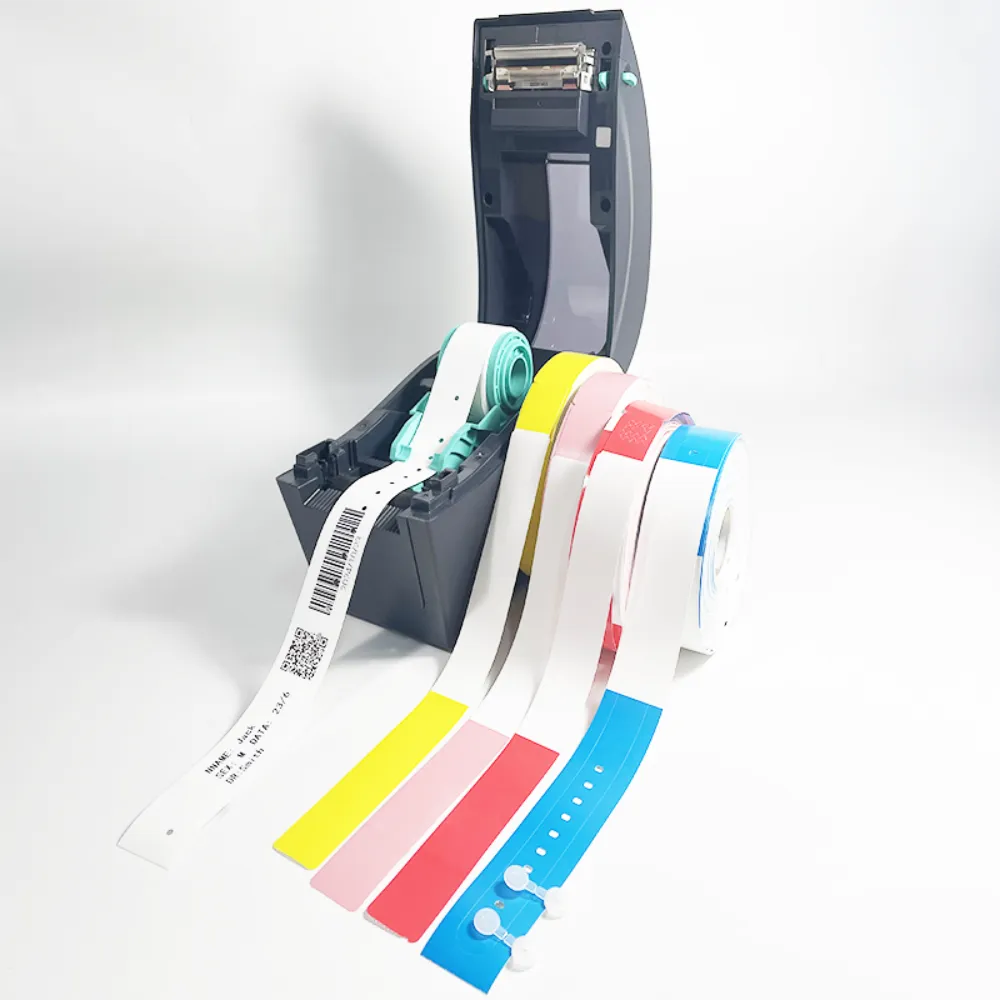
The Traditional Approach: Pre-Printed Alert Bands
Have you ever looked at a patient’s arm and seen a “sleeve” of plastic bracelets extending halfway to their elbow? When evaluating Ways to Implement Color Coding: Pre-Printed Bands vs. Color-Border Thermal Wristbands, we must first look at the incumbent method: the separate, solid-color alert band. For decades, facilities have relied on applying distinct silicone or vinyl bands—Red for Allergy, Yellow for Fall Risk, Purple for DNR—alongside the primary patient ID.
High Visibility for Immediate Recognition
The primary strength of this method is undeniable visibility. When I walk into a room and see a bright yellow band, I immediately know to initiate fall risk alert protocols. These solid blocks of color, often following AHA standardized wristband colors, act as a visual stop sign for staff. It allows for quick visual triage without needing to scan a barcode or read fine print, which is crucial for medical error prevention in high-stress environments.
The “Sleeve Effect” and Patient Comfort
However, the benefits often come at the cost of patient comfort and skin health. Stacking three or four separate bands creates what we call the “Sleeve Effect.”
- Skin Integrity: Moisture and bacteria get trapped between the bands, increasing the risk of skin breakdown, especially in elderly patients.
- Compliance Issues: Patients find the stack uncomfortable and are more likely to cut them off, leading to a total loss of identification.
Inventory Headaches and Human Error
From an operational standpoint, relying on pre-printed bands creates significant friction in the hospital admission workflow. We are forced to manage inventory for multiple SKUs at every nursing station. If a specific color runs out, the safety protocol fails. Furthermore, the manual application introduces risk:
- Missed Alerts: In a rush, staff may forget to grab the secondary band.
- Wrong Application: It is all too easy to grab a “Latex Allergy” band instead of a general “Allergy” band when boxes are cluttered.
This manual layering approach struggles to meet modern goals for wristband clutter reduction and streamlined care.
The Modern Approach: Color-Border Thermal Wristbands
We are seeing a massive shift away from stacking multiple bands on a patient’s arm. The smarter move today is on-demand thermal printing. Instead of digging through drawers for specific colored plastic loops, we use advanced thermal printers to generate a single, comprehensive wristband. This approach leverages specific Zebra/Honeywell printer configuration to print color-coded borders or text highlights directly alongside patient data.
EMR Integration for Patient ID
The biggest advantage here is safety. By linking the printer directly to the electronic medical record, we achieve seamless EMR integration for patient ID.
- Eliminates Transcription Errors: Data flows straight from the system to the wristband. No handwriting, no guessing.
- Medical Error Prevention: It stops staff from grabbing the wrong colored band by mistake. If the file says “Allergy,” the printer marks it automatically.
Wristband Clutter Reduction
This method solves the issue of patients wearing too many bands by consolidating everything into one durable strap. A single band now holds:
- Patient Demographics: Name, DOB, and MRN.
- Barcodes: Essential for medication administration scanning.
- Clinical Alerts: Fall risk alert protocols or allergy warnings appear as distinct color bars or bold text.
Inventory and Visibility
Managing stock becomes incredibly simple. We replace shelves full of different colored bands with a single SKU of thermal media. While some argue that a solid red band is more visible from across the room, modern color-border bands are designed to meet patient identification compliance while ensuring the barcode remains scannable. This balance improves the hospital admission workflow without sacrificing safety.
Critical Comparison: Workflow, Safety, and Cost
When evaluating Ways to Implement Color Coding: Pre-Printed Bands vs. Color-Border Thermal Wristbands, the decision often comes down to a tug-of-war between immediate convenience and long-term accuracy. I always tell facility managers that the cheapest option upfront isn’t always the most cost-effective when you factor in safety and labor.
Speed of Admission vs. Data Accuracy
In a high-pressure trauma center, grabbing a pre-printed band seems like the fastest route. However, this manual speed often bypasses critical safety checks. On-demand thermal printing might add a few seconds to the registration process, but it enforces EMR integration for patient ID. By tying the alert directly to the digital record, we reduce the risk of transcription errors. That small time investment upfront supports medical error prevention significantly better than relying on a nurse to remember to grab a yellow band for a fall risk.
Compliance with Safety Standards
Meeting Joint Commission patient identifier goals is non-negotiable. A major issue I see with traditional bands is “wristband clutter”—when a patient has so many separate bands that the barcodes become unreadable.
- Pre-Printed Bands: Rely heavily on staff memory to adhere to AHA standardized wristband colors (e.g., Red for Allergy, Purple for DNR).
- Thermal Solutions: Automate compliance. The printer reads the EMR data and produces a single band with the correct color coding and text, ensuring patient safety standardization without covering the patient’s arm in plastic.
Cost of Ownership Breakdown
Don’t get tricked by the low unit price of a vinyl band. The hidden costs of managing multiple SKUs and wasted inventory add up fast. Here is how the costs actually compare:
| Cost Factor | Pre-Printed Alert Bands | Color-Border Thermal Wristbands |
|---|---|---|
| Inventory Management | High complexity (Must stock 5+ colors) | High efficiency (Single stock item) |
| Waste & Shrinkage | High (Loose bands get lost/expired) | Minimal (Print exactly what is needed) |
| Workflow Impact | Fast application, disconnected data | Streamlined nursing workflow efficiency |
| Safety Risk | Vulnerable to human error | Automated adverse drug event (ADE) prevention |
Implementation Best Practices and Scenarios
Choosing between pre-printed bands and thermal printing isn’t just about preference; it is about matching the tool to the clinical environment. I have found that a “one-size-fits-all” approach rarely works in complex healthcare settings. Here is how to deploy these ways to implement color coding effectively across different departments.
Emergency Department: Trauma Triage Speed
In the ED, seconds matter. When a trauma patient arrives, nurses do not have time to log into a workstation to generate a barcode. Pre-printed alert bands are the gold standard here because they support a rapid hospital admission workflow.
- Immediate Recognition: Staff can slap on a red band for allergy warning indicators or yellow for fall risks instantly.
- No Tech Dependency: You don’t need to wait for a printer to warm up or calibrate during a crisis.
- Standardization: Using AHA standardized wristband colors ensures that any traveling nurse or EMT immediately understands the patient’s status without reading fine print.
Inpatient/Med-Surg: Comfort for Long-Term Stays
Once a patient moves to a Med-Surg unit, the priority shifts from speed to data accuracy and comfort. Here, color-border thermal wristbands shine. Patients staying for days or weeks hate wearing a “sleeve” of five different plastic bands.
- Clutter Reduction: We consolidate demographics, barcodes, and alerts onto a single band. This significantly improves nursing workflow efficiency by reducing the time spent checking multiple bands.
- Data Integrity: Printing directly from the system ensures patient safety standardization by eliminating transcription errors.
- Skin Health: A single, soft thermal band is better for skin integrity than multiple vinyl bands rubbing against the wrist.
Hybrid Solutions: Balancing Safety and Tech
Many facilities I work with opt for a hybrid model. They use on-demand thermal printing for the primary patient ID but keep a stock of pre-printed bands for critical, high-liability alerts.
Recommended Hybrid Protocol:
| Scenario | Primary Wristband | Secondary Alert Method |
|---|---|---|
| Standard Admission | Thermal band with patient ID & barcode | Digital alert in EMR |
| High Fall Risk | Thermal band (Yellow Border) | Yellow non-slip socks + Fall risk alert protocols |
| Severe Allergy | Thermal band (Red Border) | Pre-printed red band (Visual redundancy) |
| System Downtime | Handwritten generic band | Pre-printed color bands for all alerts |
Using a hybrid approach ensures that even if the printer jams or the network goes down, medical error prevention remains intact through physical visual cues.
Steps to Transition Your Facility
Switching your identification protocols requires a calculated approach to ensure patient safety standardization. When I help facilities upgrade their systems, I don’t just swap out hardware; I look at the entire ecosystem of the hospital. Here is how to effectively manage the change when exploring ways to implement color coding:
Audit Current Wristband Clutter and Workflow
The first step is looking at the patient’s arm. If you see a “sleeve” of five different bands, you have a wristband clutter reduction issue. I recommend conducting a floor audit to see how nurses currently apply alerts.
- Identify bottlenecks: Are nurses running to a separate station to grab a red allergy band?
- Assess risks: Check if bands are falling off or being applied too tightly, impacting nursing workflow efficiency.
- Review protocols: Compare your current habits against AHA standardized wristband colors to ensure you aren’t using custom colors that confuse transfer staff.
Verify EMR Printing Capabilities
Before buying stock, you must ensure your software can handle the job. EMR integration for patient ID is the backbone of the modern approach.
- Check compatibility: Whether you use Epic, Cerner, or Meditech, verify that the system supports generating color-coded cues directly on the band.
- Printer setup: Review your Zebra/Honeywell printer configuration. You need to ensure the thermal settings are calibrated so the color borders print clearly without slowing down the hospital admission workflow.
Select Durable and Antimicrobial Media
The physical wristband is the only voice the patient has when they are asleep or unconscious. Choosing cheap material is a liability.
- Durability: The print must survive showers, sanitizers, and friction.
- Hygiene: I always insist on media with an antimicrobial wristband coating. This is a critical step in infection control.
- Scanability: Ensure the material supports high-contrast printing for consistent barcode scanning to assist in adverse drug event (ADE) prevention.
Frequently Asked Questions About Wristband Color Coding
Are color-coded wristbands mandatory for all hospitals?
While strictly legal mandates vary by country, adhering to patient safety standardization is a global best practice. In many regions, facilities voluntarily adopt AHA standardized wristband colors (such as Red for Allergy, Yellow for Fall Risk, and Purple for DNR) to ensure universality. Even if not explicitly required by local law, aligning with these standards helps meet Joint Commission patient identifier goals and drastically reduces the liability associated with miscommunication during patient transfers.
Can thermal printers handle color-coded wristbands?
Yes, and this is often the most efficient method. You do not need expensive full-color inkjet printers. Standard thermal hardware—once you verify your Zebra/Honeywell printer configuration—can easily utilize color-border thermal wristbands. These bands come pre-printed with specific color zones (like a red border for allergies). The printer then adds the variable patient data and barcodes via on-demand thermal printing, allowing you to maintain EMR integration for patient ID without buying new hardware.
How do we handle patients with multiple medical alerts?
The goal is wristband clutter reduction. Stacking four or five different bands on a patient’s arm creates a “sleeve” that hides skin issues and makes reading barcodes difficult.
- Consolidate Data: Use a single thermal band that lists multiple conditions textually alongside the primary color alert.
- Prioritize Risk: If you must use physical color indicators, prioritize the most immediate life threat (usually the allergy warning indicator or fall risk alert protocols).
- Secondary Indicators: Use clasp-on color clips attached to the main ID band rather than applying separate bands.
This approach maintains nursing workflow efficiency and ensures that critical information is visible without physically overwhelming the patient.
Related Sources
https://www.zebra.com/us/en/partners/alliance-partners/epic.html
https://www.pdchealthcare.com/resources/patient-safety/color-coded-wristband-standardization.html
https://patientsafety.pa.gov/ADVISORIES/Pages/200512_22.aspx
https://www.himss.org/resources/bar-code-medication-administration-and-patient-safety
