
Subtotal ¥0.00
Compare wristband printing supplies and select medical wristband consumables paper vs thermal adhesive for durable HIPAA compliant patient ID
The Mechanics of Medical Wristband Printing Consumables
I hear the same frustrations from nursing staff and IT teams every week: constant printer jams, smudged barcodes, and entirely too much time spent wrestling with wristband printing supplies. To select appropriate medical wristband printing consumables: paper vs adhesive, we first need to evaluate the hardware driving your admissions desk.
In most healthcare facilities, patient ID printing falls into two distinct environments:
- Standard Office Laser Printers: These are your everyday, multipurpose office machines. While great for standard paperwork, using them for patient identification consumables often means forcing specialized adhesive label sheets through high-heat rollers.
- Dedicated Direct Thermal Printers: These are purpose-built, compact machines designed exclusively for high-volume, highly reliable healthcare barcode wristbands and labels.
Clarifying Wristband Terminology
The confusion over hospital patient ID bands usually starts with the materials themselves. Let’s clear up the exact terminology used in hospital procurement supplies:
- Standard Paper: This is traditional laser printer paper. It relies on expensive toner cartridges and requires a frustrating, multi-step folding and laminating process just to survive a standard hospital stay.
- Thermal Paper: This is specialized, heat-sensitive material used in direct thermal printers. It requires zero ink or toner, utilizing precisely applied heat to generate crisp text and barcodes on a thermal paper wristband roll.
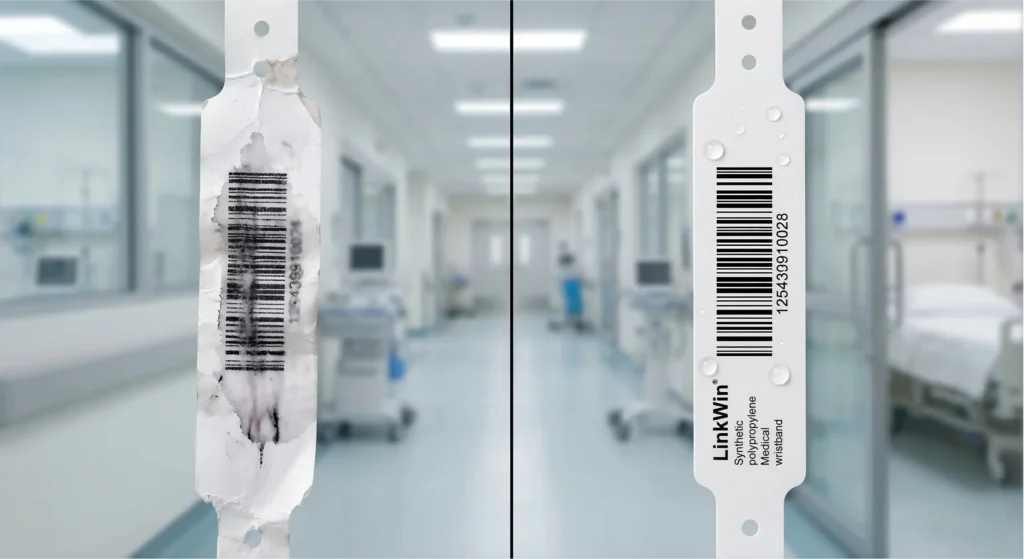
- Synthetic/Vinyl: These are premium direct thermal wristbands made from advanced plastics. These waterproof hospital wristbands easily withstand daily showers, alcohol hand sanitizers, and extended wear without degrading or causing medical barcode smudging.
Laser-Printed Paper Sheets: Hidden Costs and Workflow Bottlenecks
When you select appropriate medical wristband printing consumables, sticking with standard office laser printers might seem like a straightforward choice. However, in our experience managing hospital procurement supplies, relying on laser paper sheets introduces significant hidden costs, security risks, and operational bottlenecks that disrupt patient care.
The Risk of Severe Printer Jams
When you use standard laser printers for medical wristband printing, heat is your biggest enemy. The fuser inside a standard laser printer reaches high temperatures that easily compromise the integrity of label sheets.
- Adhesive Ooze: The intense heat melts the adhesive backing on the wristband sheet, causing sticky residue to leak into the printer’s internal mechanics.
- Costly Hardware Damage: This adhesive buildup leads to severe, recurring printer jams and permanently damaged rollers.
- IT Bottlenecks: Instead of focusing on critical infrastructure, IT teams are constantly pulled away to service ruined printers. If your goal is to reduce hospital printer jams, standard laser sheets are a primary culprit.
HIPAA Compliance and Consumable Waste
Most laser wristband solutions are manufactured as multi-label sheets. This creates an immediate problem for both hospital budgets and data security.
- Massive Consumable Waste: If an admission requires only one hospital patient ID band, printing it on a multi-label sheet renders the rest of the page useless, burning through expensive patient identification consumables.
- Security Vulnerabilities: Often, patient data inadvertently prints across adjoining labels on the sheet. To guarantee HIPAA compliant wristband printing, nursing staff are forced to manually shred and destroy the unused portions. Missing this crucial step risks a severe patient data breach.
Complex Application Processes
Time is the most valuable resource on the floor, yet laser paper bands are notoriously difficult and slow to apply. Putting one on a patient is not a simple, single-step action. It requires a frustrating, multi-step process: staff must manually punch the band out of the perforated sheet, fold it precisely, carefully apply a separate clear laminate overlay to prevent medical barcode smudging, and finally secure it to the patient. This clunky workflow drains time away from direct patient care and creates unnecessary friction for busy nursing staff.
Direct Thermal Wristbands: The LinkWin Advantage
When you need to select appropriate medical wristband printing consumables: paper vs adhesive, the right choice directly impacts your hospital’s daily workflow. As the manufacturer behind LinkWin, we specifically engineered our direct thermal wristbands to eliminate the headaches caused by standard paper and toner.
Inkless Healthcare Barcode Wristbands
Our direct thermal technology keeps the printing process incredibly simple and completely inkless. Instead of relying on expensive toner, the printer uses a heated printhead that activates a specialized, heat-sensitive thermal paper wristband roll or synthetic material. This delivers a clean, instant print on demand.
Durable Patient ID Bands
Hospital environments are tough on wristband printing supplies. We built our bands to survive the realities of patient care:
- Waterproof Hospital Wristbands: Fully resistant to water, daily showers, and bodily fluids.
- Chemical Defense: Engineered to withstand constant exposure to harsh hand sanitizers and medical-grade soaps.
- Zero Medical Barcode Smudging: Because the print is baked into the material, barcodes remain crisp and 100% scannable throughout multi-day stays, drastically reducing bedside scanning errors.
Tamper-Evident Adhesive Wristbands
Patient safety relies on accurate, continuous tracking. We design our patient identification consumables with advanced adhesive closures that prioritize security.
- Prevents “Flagging”: Our specialized adhesive lays flat and conforms securely to curved wrists, preventing the band from bulging, sticking up, or catching on bed linens.
- Shred-on-Tamper Security: If anyone attempts to peel, stretch, or transfer the band to another person, the adhesive closure instantly shreds. This tamper-evident feature ensures the ID stays exactly where it belongs.
Select Appropriate Medical Wristband Printing Consumables
Laser vs Thermal Hospital Wristbands
When we evaluate hospital procurement supplies, the choice between traditional paper and modern adhesive options dictates both your daily workflow and your bottom line. We frequently see healthcare facilities struggle with hidden costs and inefficiencies simply because they rely on outdated patient identification consumables.
To make the best choice for your medical wristband printing setup, look at the raw numbers. Here is a direct, head-to-head comparison of standard laser-printed paper sheets versus our direct thermal wristbands.
| Feature | Laser-Printed Paper Sheets | Direct Thermal Adhesive Wristbands |
|---|---|---|
| Setup Cost | Low (uses existing office printers) | Moderate (requires dedicated thermal printers) |
| Cost per Patient | High (expensive toner + high label waste) | Low (efficient, print-on-demand thermal paper wristband roll) |
| Durability | 1-2 days (high risk of medical barcode smudging) | 7-14+ days (durable, waterproof hospital wristbands) |
| Nursing Workflow | 6-step application (folding, inserting, adjusting) | 2-step peel-and-apply (fast and secure) |
| Maintenance | High (melted glue causes hospital printer jams) | Low (clean, inkless direct thermal printing) |
The Reality of Patient Identification Consumables
Paper bands might look cheap on day one, but the cost per patient skyrockets when you factor in wasted multi-label sheets and expensive toner cartridges. Upgrading to direct thermal technology eliminates the severe equipment damage caused when label sheet adhesives melt inside hot standard printers.
By switching to our tamper-evident adhesive wristbands, you instantly reduce hospital printer jams and cut IT maintenance calls to zero. The 14-day durability of these waterproof hospital wristbands ensures barcodes stay crisp through multiple washes and sanitizers, drastically outperforming standard paper. It’s a clean, two-step application process that gets nursing staff back to the bedside faster.
The ROI of Upgrading Hospital ID Systems
When we evaluate hospital procurement supplies, the focus always shifts to the bottom line. When it comes time to select appropriate medical wristband printing consumables: paper vs adhesive, making the right choice delivers a massive return. Upgrading your wristband printing supplies isn’t just a basic IT update; it is a strategic financial decision.
Offsetting Hardware Investments
Transitioning to direct thermal wristbands requires an initial budget for new dedicated printers. However, the daily operational savings rapidly offset this upfront cost:
- Zero Toner Expenses: Direct thermal technology uses heat to activate the print. You completely eliminate the recurring costs of expensive toner cartridges and ink ribbons.
- Ending Consumable Waste: Using a thermal paper wristband roll allows you to print exactly what you need on demand. You immediately stop the costly practice of throwing away half-used laser sheets just to protect patient data.
The Unquantifiable ROI
The most significant returns go far beyond the procurement spreadsheet. When we implement dedicated hospital patient ID bands on the clinical floor, the daily impact is immediate.
- Fewer Medical Errors: Highly durable, water-resistant bands eliminate medical barcode smudging. Crisp, readable barcodes mean accurate scans, directly reducing the risk of costly medical errors.
- Happier Nursing Staff: Replacing a frustrating, multi-step laser paper folding process with a simple peel-and-apply thermal band buys back valuable time. When nurses spend less time fighting equipment and assembling tags, they spend more time focused on delivering exceptional patient care.
