
Subtotal ¥0.00
In depth comparison of hospital wristband materials Tyvek vinyl and heat sensitive paper for patient safety durability and barcode accuracy
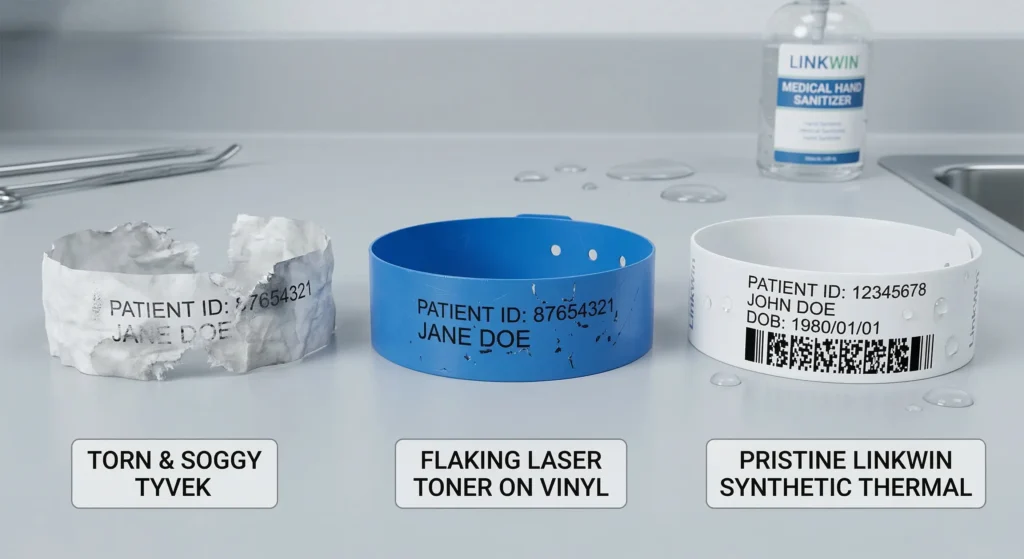
Are you seeing a spike in barcode scanning errors or facing complaints about patient skin irritation?
Selecting the right hospital wristband materials isn’t just about budget—it’s the first line of defense in patient safety.
As a specialist in medical identification, I know that a “one-size-fits-all” approach leads to wasted supplies and frustrated nursing staff. You need to know exactly when to deploy Tyvek for short-term efficiency, Vinyl for long-term durability, or Heat-Sensitive Paper for seamless on-demand data integration.
In this comparison, we’re cutting through the marketing noise to give you a technical breakdown of the advantages and disadvantages of each material, ensuring your facility makes the right choice for every department.
Let’s get into the details.
Tyvek® Wristbands: The Short-Term Economic Standard
When managing high-volume hospital admission supplies, balancing your operational budget with rigorous patient safety identification is a constant challenge. I frequently see medical facilities overspend on heavy-duty materials for very brief patient visits. For these short-term scenarios, Tyvek® patient identification wristbands remain the most practical, economic standard we recommend.
Flash-Spun High-Density Polyethylene
While it feels similar to paper, Tyvek is actually engineered from flash-spun high-density polyethylene fibers. This creates a lightweight, breathable synthetic material that completely resists tearing and snapping during routine clinical workflows.
Hospital Context: Pros and Cons
- The “Pros”:
- Cost-Efficiency: The absolute lowest cost-per-patient metric for rapid turnover departments.
- Built-in Security: Designed with aggressive adhesive and die-cut closures that physically shred upon attempted removal, instantly creating highly reliable, tamper-evident hospital bands.
- Lightweight Comfort: Unobtrusive and easy to apply on patients requiring immediate, brief medical attention.
- The “Cons”:
- Limited Longevity: Engineered strictly for short-term use. The material begins to show wear and can trap moisture after 24 to 48 hours.
- Texture: The slightly stiff, papery edges can become an irritant during extended inpatient stays, lacking the softness required for highly vulnerable skin.
Best Clinical Use Cases
By matching the material’s specific 24-48 hour durability window to the right department, you eliminate unnecessary spending while maintaining secure identification. Deploy Tyvek wristbands strictly for:
- Emergency Rooms (ER) and Triage
- Outpatient Surgery Centers
- Day Clinics and Rapid Diagnostics
Vinyl Hospital Wristband Materials: The Long-Term Care Champion
When we compare hospital wristband materials—especially in the standard Tyvek vs vinyl matchup—vinyl is the undisputed winner for extended patient stays. These long-term care wristbands are constructed from a multi-layered synthetic material and feature a permanent locking snap closure. This specific design creates highly secure, tamper-evident hospital bands that cannot be removed and transferred, ensuring absolute data integrity throughout a patient’s visit.
The Pros and Cons
- The “Pros”
- Durability: Built to withstand constant exposure to water, soaps, and friction for weeks without degrading.
- Security: The locking snap guarantees accurate patient safety identification, as the band must be destroyed to be removed.
- Comfort: The smooth, flexible layers prevent chafing and skin irritation during extended wear.
- The “Cons”
- Cost: The premium synthetic build and snap hardware require a higher upfront investment compared to basic bands.
- Lead Time: Custom designs or large volume orders can sometimes require slightly longer manufacturing times.
Ideal Hospital Use Cases
- Inpatient Wards: The standard choice for routine, multi-day hospital admission supplies.
- NICU: Specialized soft vinyl variations serve perfectly as gentle, non-irritating neonatal ID bands.
- Oncology & Long-Term Rehabilitation: Provides reliable, comfortable identification for weeks of ongoing treatments, eliminating the need for constant re-banding.
Heat-Sensitive (Direct Thermal) Wristbands: The Data Integrity Solution
When we talk about modern hospital wristband materials, direct thermal bands are often the heavy lifters for data accuracy. To be clear, these aren’t just paper; they are typically a durable synthetic material (like polypropylene) treated with a special thermal coating. This design allows you to print patient information on-demand without needing messy ink ribbons.
Why Hospitals Are Switching to Thermal
The biggest advantage here is barcode readability. In a busy ward, you can’t afford a scanner failure. Direct thermal printing produces crisp, high-contrast barcodes that scan correctly the first time, which is critical for Bedside Medication Verification (BMV) protocols.
- Workflow Efficiency: Because they print directly from your admission system, staff can generate a band in seconds right at the desk.
- Resistance: Good quality thermal bands are built to handle exposure to water, soap, and hand sanitizers without the text smudging or fading.
Limitations to Consider
While they are excellent for data, they have specific vulnerabilities. The main “Con” is heat sensitivity. Since the image is created by heat, leaving boxes of these bands in a hot warehouse or a sun-drenched ambulance dashboard can ruin the stock before you even use it. They also have a defined shelf life compared to inert materials like vinyl.
Best Use Case
These are the go-to choice for facilities running fully Integrated Hospital Information Systems (HIS). If your hospital relies on scanning patient ID bands for everything from drug administration to lab samples, the superior scan rates of direct thermal bands make them the only logical choice.
Comparative Analysis: The Decision Matrix
Choosing the right hospital wristband materials isn’t just about picking a color; it’s about balancing budget with patient safety. I’ve seen too many facilities overspend on short-term patients or, worse, use cheap bands that fail during critical bedside medication verification (BMV).
To help you make the call, I’ve broken down the three main contenders—Tyvek, Vinyl, and Heat-Sensitive (Direct Thermal)—against the criteria that actually matter on the hospital floor.
Tyvek vs. Vinyl vs. Direct Thermal: The Breakdown
When we look at Tyvek vs Vinyl or compare them to thermal options, we are weighing longevity against workflow efficiency. Here is how they stack up in a real-world medical environment.
| Criteria | Tyvek® Wristbands | Vinyl Wristbands | Direct Thermal (Synthetic) |
|---|---|---|---|
| Durability (Days) | Short-term (1-2 days) | Long-term (14+ days) | Medium-term (7-14 days) |
| Water Resistance | Moderate (Splash-proof) | Excellent (Fully waterproof) | High (Resists fluids & alcohol) |
| Barcode Scannability | Low (Often handwritten or labelled) | Low (Unless using insert cards) | Superior (Direct print clarity) |
| Patient Comfort | Good (Paper-like feel) | High (Smooth, soft edges) | High (Flexible & lightweight) |
| Cost | Lowest | Moderate to High | Moderate |
| Security | Tamper-evident cuts | Locking snap closure | Tamper-evident adhesive |
Key Takeaways:
- Go with Tyvek if your priority is pure cost control for high-volume, short-stay areas like outpatient clinics.
- Choose Vinyl for long-term care where the band needs to survive weeks of showers and wear without irritating the skin.
- Stick with Direct Thermal if your facility relies on barcode scannability rates for patient safety. The ability to print high-resolution data directly onto the band makes it the gold standard for modern, integrated hospital systems.
How to Choose Based on Department Needs
Not every department in a hospital operates at the same pace or faces the same risks. What works for a patient rushing through the ER won’t necessarily work for a newborn in the NICU. When I advise hospitals on patient identification wristbands, I always start by looking at the specific workflow of each unit. You have to match the material to the environment.
ER & Triage: Speed and Cost Efficiency
In the Emergency Room, chaos is the norm. The priority here is rapid processing. You need a solution that can be applied in seconds and doesn’t break the budget, especially since many ER visits are short-term.
- Top Pick: Tyvek® Wristbands or Standard Direct Thermal.
- Why: Tyvek is incredibly cost-effective and easy to secure quickly. For hospitals using digital tracking immediately upon entry, a standard direct thermal medical band offers the best balance of speed and scannability.
- Key Requirement: Fast application and tamper-evidence.
Maternity & NICU: Softness and Safety
The requirements change drastically when dealing with infants and new mothers. Neonatal skin is incredibly fragile; a standard stiff plastic band can cause irritation or injury. Here, comfort isn’t a luxury—it’s a medical necessity.
- Top Pick: Soft Vinyl or Ultrasoft Thermal.
- Why: We focus on hypoallergenic wristband materials that are gentle on sensitive skin. Neonatal ID bands often feature a foam backing or ultra-soft coating to prevent chafing.
- Key Requirement: Hypoallergenic properties and extreme comfort.
Med-Surg & ICU: Scan Reliability and Resistance
In Medical-Surgical units and the ICU, patients stay longer and undergo more procedures. The wristband is the critical link for Bedside Medication Verification (BMV). If a nurse scans a band and it fails because of water damage or fading, patient safety is compromised.
- Top Pick: Premium Direct Thermal (Polypropylene).
- Why: These bands need to survive showers, sanitizers, and constant friction against bedsheets. A polypropylene thermal wristband with an alcohol-resistant wristband coating ensures the barcode remains readable for the entire stay.
- Key Requirement: High barcode scannability rates and fluid resistance.
| Department | Primary Goal | Recommended Material | Critical Feature |
|---|---|---|---|
| ER / Triage | Speed of Admission | Tyvek® or Economy Thermal | Cost-efficiency & Quick Application |
| Maternity / NICU | Patient Safety & Comfort | Soft Vinyl or Ultrasoft Thermal | Hypoallergenic & Non-abrasive |
| Med-Surg / ICU | Data Integrity (BMV) | Premium Coated Thermal | Alcohol Resistance & Durability |
The LinkWin Advantage in Hospital Wristband Materials
Whether your facility is evaluating Tyvek vs vinyl or upgrading to direct thermal, the true test of hospital wristband materials comes down to everyday reliability on the ward. At LinkWin, we engineer our patient identification wristbands to meet the highest clinical standards. We do more than supply bands; we provide secure patient safety identification solutions built for the real-world demands of global healthcare workers.
Medical-Grade Assurance
Our proprietary manufacturing process delivers uncompromising quality:
- Alcohol-Resistant Wristband Coating: We use specialized protective coatings that lock in thermal printing. Constant exposure to hand sanitizer and alcohol wipes will not fade, smear, or erase critical patient data.
- Anti-Microbial Options: Our catalog includes uniquely treated materials that actively resist bacterial growth, adding a vital layer of infection control at the bedside.
- ISO Certified Quality: Every batch of our medical grade synthetic paper and synthetic bands is backed by strict international ISO certifications, ensuring safe, consistent, and reliable performance in any hospital environment.
